Branding · 7 min read
What is brand identity? The elements, real examples and how to build one
Brand identity is the set of choices that make a company recognisable and believable everywhere it shows up. Here is a clear definition, the nine elements, how identity differs from branding and brand image, real examples and how to build your own.

Jakaria MahmudBrand strategist and brand identity designer ·
People rarely remember what a company says. They remember how it looked, how it sounded and how it made them feel, and they decide in seconds whether it seems trustworthy. Brand identity is the part of that impression a company controls. Get it right and every website, deck, post and invoice quietly builds recognition. Get it wrong and even a great product looks like a risk.
I am Jakaria Mahmud, a brand strategist and brand identity designer working with startups, SaaS and growing companies in the USA, UK, the Gulf and Europe. This guide explains what brand identity is, its nine elements, how it differs from branding and brand image, real examples and how to build one step by step.
Short answer. Brand identity is the collection of visible and verbal elements a company uses to present itself and be recognised: its logo, colour palette, typography, imagery, graphic elements, tone of voice and the rules that tie them together in brand guidelines. A strong brand identity is built on strategy, so it expresses who the company serves and why it is different, and it is applied consistently across every touchpoint.
What is brand identity?
Brand identity is how a business chooses to look and sound so that people recognise it and understand what it stands for. It is intentional: the company designs it. That is the key difference from brand image, which is what people actually think of you. A good identity closes the gap between the two, so the impression customers form is the one you meant to create.
Brand identity is more than a logo. The logo is the signature, but the identity is the whole handwriting: colours, type, imagery, layout, language and the rules that make them work together.
The 9 elements of brand identity
| Element | What it is | Why it matters |
|---|---|---|
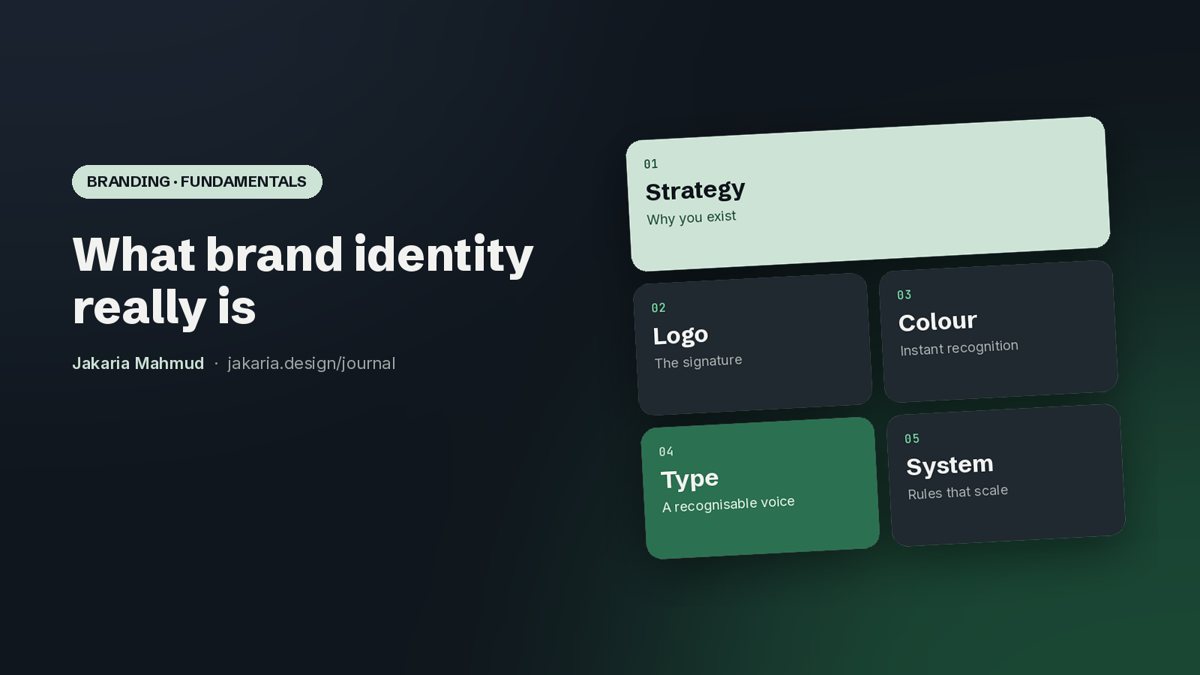
| 1. Brand strategy | Audience, positioning, promise and personality | Gives every design choice a reason |
| 2. Name | The word people use for you | Memorable, available and protectable |
| 3. Logo | Primary logo, compact mark and icon | The fastest signal of who you are |
| 4. Colour palette | Primary, secondary and neutral colours | Often recognised before the name is read |
| 5. Typography | Typefaces for headings, text and numbers | Sets tone and keeps everything readable |
| 6. Imagery | Photography, illustration and icon style | Shows your world without words |
| 7. Graphic elements | Shapes, patterns, grids and motion | Makes layouts recognisable even without the logo |
| 8. Tone of voice | How the brand writes and speaks | Makes every message sound like one company |
| 9. Brand guidelines | The rules for using all of the above | Keeps the identity consistent as you grow |
You can see what a full set of these deliverables looks like in what a brand identity package includes, and how the rules are documented on the brand guidelines page.
Brand identity vs branding vs brand vs brand image
| Term | Meaning | Who controls it |
|---|---|---|
| Brand | The overall reputation and feeling people have about a company | Shaped by the company, decided by customers |
| Branding | The ongoing work of shaping that perception | The company |
| Brand identity | The designed toolkit: logo, colour, type, voice and rules | The company |
| Brand image | What people actually think and feel today | Customers and the market |
In short: brand identity is the tool, branding is the work and brand image is the result. Strategy sits underneath all of it; read what a brand strategist does for that layer.
What makes a strong brand identity
- Distinctive. It looks and sounds different from competitors in your category.
- Relevant. It speaks to the audience you want, not to everyone.
- Consistent. Every touchpoint uses the same system, so recognition builds over time.
- Flexible. It works on a phone screen, a pitch deck, a truck and a social post.
- Simple. Few colours, few typefaces and clear rules are easier to apply correctly.
- Built on strategy. Every choice can be explained in terms of the position you want to own.
Brand identity examples
The best-known identities show how far consistency goes. Many people recognise a soft drink by its red or a jewellery brand by its shade of blue before they read a word, because those companies have used the same colours, type and tone for decades. Smaller companies can use the same principle on a smaller budget.
A few identities from my own work show how this applies to startups and growing businesses:
- Nurency: a logo system with primary logo, app icon, reversed version and sizes tested down to 20 pixels. See it on the logo design page.
- MYPA: a fintech identity designed to feel simple and trustworthy. See MYPA on Behance, and read more in fintech branding.
- R-Load: an EV charging brand identity. See R-Load on Behance, and read sustainable energy branding.
- INGLIS Contractors: branding for an infrastructure company. See INGLIS on Behance, and read construction company brand identity.
How to create a brand identity: 7 steps
- Define your strategy. Who you serve, what you replace and why you win. See brand strategy.
- Research the market. Collect competitor identities and find the visual and verbal space nobody owns.
- Set your personality. Choose three words for how the brand should feel and use them to judge every option.
- Design the logo system. Primary logo, compact mark and icon, tested at real sizes.
- Build the system. Colour, typography, imagery, graphic elements and tone of voice that work together.
- Apply it to real touchpoints. Website, deck, social, product and documents, before finalising.
- Write the guidelines. Clear rules and templates so the identity stays consistent as the team grows.
For the full workflow, read the brand identity design process. Budgeting? See brand identity design cost in the USA, branding cost in the UK or how much a logo costs.
Brand identity mistakes to avoid
- Starting with the logo. Without strategy, design is decoration.
- Following trends. Fashionable effects date fast and look like everyone else.
- Too many options. Five fonts and ten colours make consistency impossible.
- No guidelines. The identity drifts the moment a second person designs something.
- Changing too often. Recognition comes from repetition. If the strategy has changed, plan a proper rebrand instead of constant tweaks.
Where I fit: Jakaria Mahmud
I build brands with a business mindset and grow businesses with a brand mindset. I design brand identities from strategy first, for startups, SaaS and growing companies, and hand over every file, the guidelines and full ownership.
- Services: brand identity design, logo design, brand guidelines, brand strategy and rebranding.
- Markets: the USA, UK, UAE, Saudi Arabia, Qatar, Europe and Bangladesh.
- Pricing: from $799 one time for a starter identity and landing page, or $1,999 per month for a full identity, guidelines and website.
- Proof: 80+ clients in 12 countries, $1.4M+ in revenue impacted and a 5.0 rating on Google.
What is changing next? See the branding trends for 2027.
The takeaway
Brand identity is the designed system that makes a company recognisable and believable: strategy underneath, then name, logo, colour, type, imagery, graphic elements and voice, held together by guidelines. Build it on a clear position, keep it simple and apply it consistently, and every touchpoint starts doing part of your selling.
Frequently asked questions
Brand identity is the collection of visible and verbal elements a company uses to present itself and be recognised, including its logo, colour palette, typography, imagery, graphic elements, tone of voice and the brand guidelines that tie them together.
The core elements are brand strategy, name, logo, colour palette, typography, imagery, graphic elements, tone of voice and brand guidelines.
Brand identity is the designed toolkit, such as the logo, colours, type and voice. Branding is the ongoing work of shaping how people see the company, using that toolkit.
Brand identity is how the company intends to be seen. Brand image is how people actually see it. A strong, consistent identity narrows the gap between the two.
No. A logo is one element of a brand identity. The identity also includes colours, typography, imagery, graphic elements, tone of voice and the rules for using them.
Define the strategy, research competitors, set the brand personality, design the logo system, build colour, type, imagery and voice, apply them to real touchpoints and document everything in brand guidelines.
It ranges from a few hundred dollars for a starter kit to tens of thousands with large agencies. Jakaria Mahmud offers a starter identity from $799 and full brand identities with guidelines in the $1,999 per month Partner plan.