Branding · 8 min read
The brand identity design process: 7 steps from strategy to brand guidelines
A strong brand is not drawn, it is built in order. Here is the seven step brand identity design process I use with founders in the USA, UK, the Gulf and Europe, and what you should get at each step.

Jakaria MahmudBrand identity and UI/UX designer ·
Most weak brands are not the result of bad taste. They are the result of skipping steps. A logo gets designed before anyone agrees who the brand is for, colours get picked before the positioning is clear, and nobody writes down the rules, so the brand slowly falls apart. A good brand identity design process fixes that by doing the work in the right order.
I am Jakaria Mahmud, a brand identity designer working with startups and growing companies in the USA, UK, UAE, Saudi Arabia, Qatar, Switzerland, the Netherlands and Bangladesh. This is the exact process I follow, with what happens at each step, what you should receive and how long it usually takes.
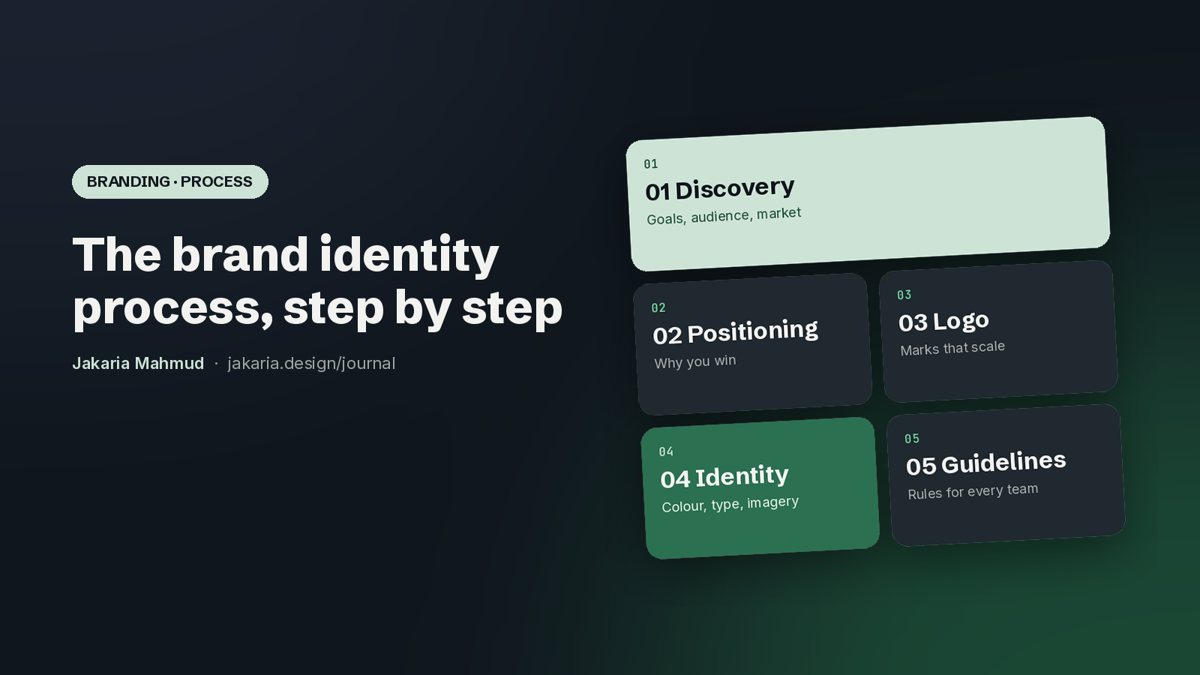
Short answer. The brand identity design process has seven steps: 1) discovery, 2) positioning and messaging, 3) creative direction, 4) logo design, 5) visual identity system, 6) key applications and 7) brand guidelines and handover. Strategy comes first, design second and documentation last. A focused starter identity takes about one week, and a full identity with guidelines usually takes three to five weeks.
The 7 steps at a glance
| Step | Goal | What you receive | Typical time |
|---|---|---|---|
| 1. Discovery | Understand the business, audience and market | Written brief and competitor audit | 1 to 3 days |
| 2. Positioning | Decide who you serve and why you win | Positioning statement and key messages | 2 to 4 days |
| 3. Creative direction | Agree on the look and feel before detailed design | One or two direction boards | 2 to 3 days |
| 4. Logo design | Create a distinctive mark that scales | Primary logo, compact mark and icon | 3 to 6 days |
| 5. Visual identity | Build the system around the logo | Colour, typography, imagery and layout rules | 3 to 5 days |
| 6. Applications | Prove the identity works in real use | Website direction, deck, social and print templates | 3 to 7 days |
| 7. Guidelines | Make the brand easy to use correctly | Brand guidelines and full file handover | 2 to 4 days |
Step 1: Discovery
Discovery is where the project is won or lost. The goal is to understand the business well enough that design decisions can be judged against something real, not personal taste.
- Business goals. What should the brand help you do in the next 12 months: raise a round, win bigger clients, enter a new country or hire?
- Audience. Who buys, who influences the decision and what they need to believe before they say yes.
- Competitors. How the main competitors look and sound, and where there is space to stand out.
- Constraints. Languages, markets, existing assets to keep, trademarks and deadlines.
You receive: a one page brief we both sign off on. Every later step is checked against it.
Step 2: Positioning and messaging
Positioning decides what the brand stands for. It is the most valuable step and the one most often skipped. Without it, a logo is just decoration.
- A clear statement of who you serve, what you do and why you are the better choice.
- Three to five key messages, each backed by proof.
- A one line description people can repeat.
- Tone of voice: how the brand sounds in a pitch, a proposal and a support reply.
You receive: a short positioning and messaging document, approved before any design starts.
Step 3: Creative direction
Before drawing a single logo, agree on where the brand should sit visually. Direction boards combine type, colour, imagery and reference layouts to show a feeling, such as precise and technical, warm and human, or bold and premium.
This step prevents the most expensive problem in branding: a beautifully executed logo in the wrong direction. Picking a direction first makes the next steps faster and the feedback much clearer.
You receive: one or two directions, each tied back to the positioning.
Step 4: Logo design
With a direction approved, logo design becomes focused. A good logo is simple, distinctive, legible at small sizes and true to the positioning. It also has to work as a system, not a single file.
- Primary logo for the website, deck and documents.
- Compact mark or symbol for social avatars, favicons and app icons.
- Versions for dark and light backgrounds and one colour use.
- Tests at favicon size, on mobile, on signage and next to competitors.
For a deeper look at logo types and what a complete logo package includes, see my logo design service.
You receive: the final logo system in SVG, PDF and PNG, with the editable source.
Step 5: Visual identity system
The logo is only a small part of what customers see. The visual identity system is everything around it that makes the brand recognisable even when the logo is not on screen.
- Colour palette with primary, secondary and neutral colours, checked for accessible contrast.
- Typography for headings, body text and interface, with licences confirmed.
- Imagery: photography style, illustration or icon rules.
- Layout: grids, spacing and how elements combine.
- Language versions where needed, such as Arabic and English or German and French, designed together rather than added later.
You receive: the identity system in Figma, ready for designers and developers.
Step 6: Key applications
An identity is only proven when it is used. This step designs the touchpoints that matter most for your goals, so you launch with real assets instead of a logo file and good intentions.
- Website direction or a landing page
- Pitch deck or sales deck
- Social media templates
- Business cards, email signature and proposal templates
- Product UI tokens for SaaS teams
Pick the three or four you will use in the next six months. Everything else can follow.
Step 7: Brand guidelines and handover
Brand guidelines turn the work into something your whole team, agencies and future hires can use correctly without asking the designer every time. Good guidelines are short, visual and practical, with clear do and do not examples.
- Positioning, messaging and tone of voice
- Logo usage, clear space, minimum size and misuse
- Colour values for screen and print
- Typography hierarchy and fallback fonts
- Imagery and layout rules with examples
- Templates and where to find every file
Read more on how I build them on the brand guidelines design page.
You receive: the guidelines as a PDF and a Figma file, all source files and full ownership in writing.
How long the brand identity process takes
A focused starter identity, meaning a logo system, core colours and type and one landing page, takes about one week. A full identity with positioning, applications and guidelines usually runs three to five weeks. Larger agencies often take two to four months because of research and approval layers. The biggest factor you control is feedback speed: one decision maker and replies within a day keep the project moving.
Running the process with an international designer
Every step above works fully remotely. Discovery happens on a video call, work is shared in one Figma file, and each step ends with a written summary and an approval. Time zones can even speed things up, because work continues while you sleep.
- USA: your morning is my evening, so updates land overnight. See brand identity designer for the USA.
- UK and Europe: same day feedback. See the UK, Switzerland and Netherlands pages.
- Gulf: two to three hours apart with a full working day overlap, and Arabic and English identities designed together. See Dubai and the UAE, Saudi Arabia and Qatar.
- Bangladesh: in person workshops are possible. See brand identity designer in Dhaka.
Common mistakes in the branding process
- Starting with the logo. Without positioning, there is nothing to judge the logo against.
- Too many decision makers. Feedback by committee produces safe, forgettable brands.
- Asking for 20 concepts. More options means less thinking per option.
- Testing only on a big screen. Most people meet your brand on a phone or as a tiny icon.
- Skipping guidelines. The brand looks great at launch and inconsistent six months later.
- Not getting the source files. Every future change becomes a new invoice.
Brand identity process checklist
- Signed brief with goals, audience and competitors
- Approved positioning and key messages
- One agreed creative direction
- Logo system tested at small sizes and on dark and light backgrounds
- Colour, typography, imagery and layout rules
- Three or four key applications designed
- Brand guidelines with do and do not examples
- All source files and full ownership in writing
Where I fit: Jakaria Mahmud
I build brands with a business mindset and grow businesses with a brand mindset. Every project follows this seven step process, with one senior designer accountable from the first call to the final handover.
- Launch, $799 one time: a logo and brand starter kit plus one landing page, in about a week.
- Partner, $1,999 per month: full brand identity and guidelines, website UX and UI, product design and development.
- Proof: 80+ clients in 12 countries and a 5.0 rating on Google.
See the full brand identity design service, what goes into a brand identity design package, and what a brand costs in the USA pricing guide.
The takeaway
A strong brand identity is built in order: understand the business, decide the positioning, agree a direction, design the logo, build the system around it, prove it in real applications and write it all down. Follow those seven steps and the brand will look right on day one and stay consistent as you grow, in any market.
Frequently asked questions
It is the step by step method for creating a brand: discovery, positioning and messaging, creative direction, logo design, the visual identity system, key applications and brand guidelines with a full file handover. Strategy comes before design, and documentation comes last.
A starter identity with a logo system and one landing page takes about one week. A full identity with positioning, applications and guidelines usually takes three to five weeks, and large agency rebrands can take two to four months.
The strategy. Positioning and messaging should be approved before the logo is designed, because they are what every design decision is judged against.
Positioning and tone of voice, logo usage and misuse, colour values for screen and print, typography, imagery and layout rules with examples, templates and where to find every file.
Yes. Discovery runs on video calls, work is shared in one Figma file and each step ends with a written approval. I work this way with clients in the USA, UK, the Gulf and Europe.
Quality matters more than quantity. One or two well reasoned directions tied to the positioning are more useful than many unrelated concepts.
One decision maker plus one or two people who know customers well, such as a founder and a sales or marketing lead. Fewer voices lead to clearer, more distinctive brands.