Branding · 7 min read
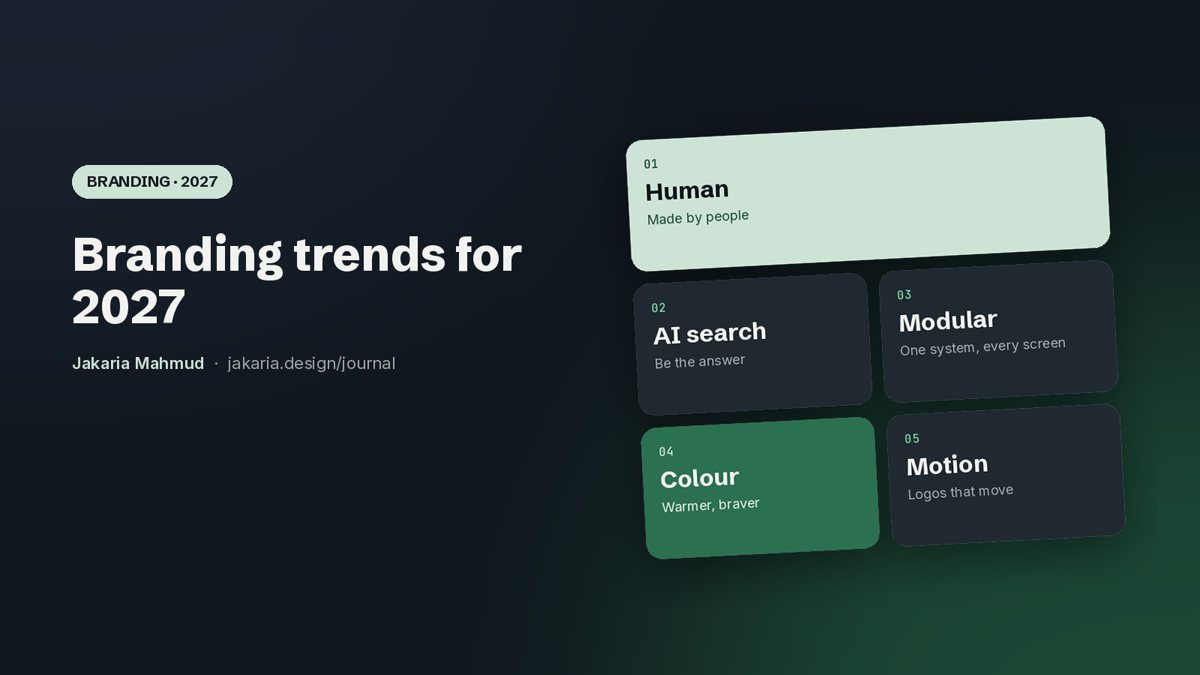
Branding trends 2027: the 10 shifts every startup and growing brand should plan for
Branding in 2027 is shaped by AI everywhere, buyers who trust human craft, and identities that have to work on every screen and inside AI answers. Here are ten shifts to plan for, and what each one means for a startup or growing brand.

Jakaria MahmudBrand strategist and brand identity designer ·
Every year brings a new list of fashionable fonts and colours. Most of it does not matter. What matters in 2027 is bigger: people now discover brands through AI assistants as well as search engines, they are surrounded by machine-made content, and every brand has to work across more screens than ever. Those forces decide which brands get noticed, trusted and chosen.
I am Jakaria Mahmud, a brand strategist and brand identity designer working with startups, SaaS and growing companies in the USA, UK, the Gulf and Europe. These are the ten branding shifts I am planning around with clients for 2027, with what each one means in practice. They are forecasts based on current research and client work, not certainties, so use them as a lens rather than a checklist.
Short answer. The biggest branding trends for 2027 are: human-made design as a trust signal, brands built to be understood by AI search, modular identity systems that work on every screen, warmer and more emotional colour, calmer layouts with characterful type, logos designed for motion, community-led identity, radical transparency, founder-led personal brands and bilingual identities for global growth. Underneath all of them is one rule: a clear position, expressed consistently everywhere.
The 10 branding trends for 2027
1. Human-made becomes a premium signal
As AI-generated images and copy flood every feed, visible human craft stands out: hand-drawn marks, real photography, imperfect textures and writing with a point of view. Research from Mintel, reported by Netpeak, found that 63% of Britons say AI makes them appreciate things made by people. What to do: keep AI for speed, but make sure the parts customers see first, such as the logo, hero imagery and headline, carry an unmistakably human hand.
2. Branding for AI search, not only Google
More people ask ChatGPT, Gemini, Claude and Google's AI Overviews which company to choose. Those systems recommend brands they can clearly understand: a consistent name, a clear description of what you do and for whom, and the same facts repeated across your website, profiles and reviews. What to do: write one plain sentence about who you serve, use it everywhere, keep your Google Business Profile and social bios consistent, and publish useful answers to your customers' questions.
3. Modular identity systems
A brand now lives on an app icon, a pitch deck, a short video, a product dashboard and a billboard, sometimes on the same day. Rigid logo-first identities break. Flexible systems of marks, grids, colour roles and motion rules hold together. What to do: design the system, not just the logo, and document it in brand guidelines that cover digital, product and social.
4. Warmer, more emotional colour
After years of cool blues and greys, brands are moving to warmer, braver palettes that signal energy and approachability. Even in categories like fintech and SaaS, a single ownable accent colour does more than another safe blue. What to do: keep a calm base for trust, then own one accent colour your competitors do not use. See how this works in fintech branding.
5. Calmer layouts, characterful type
Busy, attention-grabbing websites are giving way to calmer layouts with more space and fewer elements. Personality moves into typography, with refined serifs and custom wordmarks doing the work that effects used to do. What to do: remove anything that does not help a buyer decide, and invest in one distinctive typeface rather than many decorative ones.
6. Logos designed to move
Most brand impressions now happen in video and interfaces, so logos are increasingly designed with motion in mind: how they reveal, loop and react. What to do: when you design or refresh a logo, define a simple motion behaviour at the same time. A short logo animation, like the OneClick logo animation, makes a brand feel finished on screen.
7. Community-led identity
Brands are shifting from aspiration ("be like us") to belonging ("this is our group"). Customers, users and fans increasingly shape the story. What to do: give your community something to use, such as templates, badges or a recognisable visual language, and feature real customers instead of stock people.
8. Radical transparency
Trust is the currency of 2027. Clear pricing, honest claims, real reviews and openness about how you use AI all build it. Regulators are tightening too, from the FTC's rule on fake reviews in the USA to financial promotion rules in the UK. What to do: publish your prices or ranges, show real proof and never fake reviews or testimonials.
9. Founder-led personal brands
Buyers trust people more than logos. Founders who share their thinking on LinkedIn, X or video give a company a face and a voice that no campaign can copy. What to do: align the founder's personal brand with the company brand, with the same positioning, tone and visual cues. Read personal branding and positioning.
10. Bilingual and local identities for global growth
Startups expand across borders earlier than ever, and markets like the UAE and Saudi Arabia expect brands that work in Arabic as well as English. Identities designed in one language and translated later rarely feel native. What to do: if a new market is on your 2027 plan, design both language versions together. See brand identity design in Dubai.
2027 branding trends at a glance
| Trend | Why it matters in 2027 | First step |
|---|---|---|
| Human-made design | Stands out in an AI-saturated feed | Make the logo and hero imagery visibly human |
| AI search branding | AI assistants recommend brands they understand | One clear description used everywhere |
| Modular systems | Brands live on more screens than ever | Guidelines that cover digital and product |
| Warmer colour | Cool, safe palettes all look alike | Own one accent colour |
| Calmer layouts | Buyers are tired of noise | Cut every element that does not help a decision |
| Motion-first logos | Most impressions happen in video and apps | Define a simple logo animation |
| Community identity | Belonging beats aspiration | Feature real customers |
| Transparency | Trust decides the sale, and rules are tightening | Show prices and real proof |
| Founder brands | People trust people | Align founder and company positioning |
| Bilingual identity | Earlier global expansion | Design language versions together |
Trends you should not chase
- Copying a big brand's rebrand. What works for a household name with huge recognition rarely works for a startup that needs to be understood first.
- Fully AI-generated logos. They are fast, but often generic, hard to protect and similar to everyone else's.
- Effects that date quickly. Heavy gradients, chrome and glitch effects look tired within a year or two.
- Changing for the sake of change. A trend is only worth adopting if it helps your position. If your strategy is still right, a refresh beats a rebrand.
How to use these trends in your 2027 plan
- Start from strategy. Decide who you serve and why you win, then judge every trend against that. See what a brand strategist does.
- Audit your current brand. Is it consistent, distinctive and understood by both people and AI search?
- Pick two or three trends, not ten. The ones that support your position and your next market.
- Decide refresh or rebrand. If the business has changed, read rebranding in 2027 and the full rebranding guide.
- Update the system, not just the logo. Colour roles, type, motion, templates and guidelines.
Where I fit: Jakaria Mahmud
I build brands with a business mindset and grow businesses with a brand mindset. For 2027 that means identities built on a clear position, designed as flexible systems, made to be understood by both people and AI search, and ready for new markets.
- Services: brand strategy, brand identity design, logo design, brand guidelines and rebranding.
- Markets: the USA, UK, UAE, Saudi Arabia, Qatar, Europe and Bangladesh.
- Pricing: from $799 one time, or $1,999 per month for full strategy, identity, guidelines and website.
- Proof: 80+ clients in 12 countries, $1.4M+ in revenue impacted and a 5.0 rating on Google.
The takeaway
Branding in 2027 rewards brands that are human, clear and consistent: visibly made by people, understood by AI search, built as flexible systems and honest about what they offer. Pick the few trends that support your position, ignore the rest, and apply them across your whole system rather than only your logo.
Further reading: Netpeak on marketing trends for 2026 and 2027 and BIGEYE on 2027 design trends.
Frequently asked questions
Human-made design as a trust signal, branding for AI search, modular identity systems, warmer and more emotional colour, calmer layouts with characterful type, motion-first logos, community-led identity, radical transparency, founder-led personal brands and bilingual identities for global growth.
AI assistants and AI Overviews recommend brands they can clearly understand. Brands need a consistent name and description, the same facts across their website, profiles and reviews, and useful content that answers customers' questions.
Simpler marks that work as app icons, logos designed with motion in mind, visible human craft such as custom lettering, and identity systems where the logo is one part of a flexible kit rather than the whole brand.
Only if the trend supports your position or your business has changed. If your strategy is still right and only the look is dated, a brand refresh is usually enough.
AI speeds up production, but strategy, distinctiveness and human craft are what make a brand trusted and protectable. In 2027 those qualities are becoming more valuable, not less.
Start from a clear position, audit the current brand, pick two or three trends that support that position, and apply them across the whole identity system and guidelines rather than only the logo.