Branding · 7 min read
Rebranding in 2027: should you rebrand, and how to plan it so you keep customers and rankings
If your brand no longer fits your business, 2027 is a good year to fix it, but only with a plan. Here is how to decide if you need a refresh or a rebrand, a quarter by quarter timeline, budget, and how to rebrand without losing customers, Google rankings or visibility in AI search.

Jakaria MahmudBrand strategist and brand identity designer ·
Many companies end the year knowing their brand no longer fits. They sell to bigger customers, they have a new product or market, or the brand built for a seed round now looks smaller than the business. A new year is a natural point to fix that. But a rebrand started without a plan can cost recognition, customers and search rankings, and in 2027 it can also confuse the AI assistants that now recommend companies.
I am Jakaria Mahmud, a brand strategist and brand identity designer who rebrands startups, SaaS and growing companies in the USA, UK, the Gulf and Europe. This guide helps you decide whether to rebrand in 2027, and if so, how to plan it quarter by quarter. For the general step by step process, read the full rebranding guide.
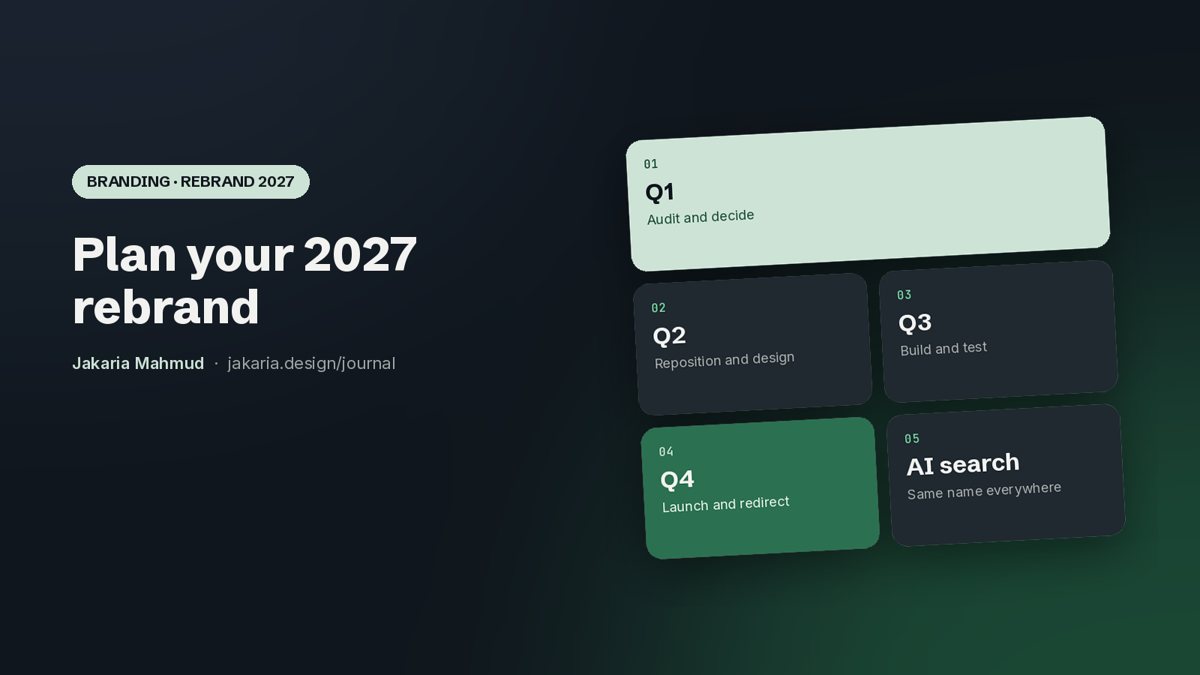
Short answer. Rebrand in 2027 if your business has changed and the brand no longer matches it: new customers, a new offer, a new market or a merger. If only the look is dated, choose a brand refresh instead. Plan it across the year: audit and decide in Q1, reposition and design in Q2, build and test in Q3, and launch in Q4 with redirects, updated profiles and one consistent name and description everywhere, so Google and AI search follow the change.
Should you rebrand in 2027? 7 questions
Answer yes or no. Three or more yes answers usually mean a rebrand is worth exploring.
- Do you now sell to a different or larger customer than when the brand was created?
- Has your product, offer or business model changed significantly?
- Are you entering a new market in 2027, such as the USA, UK or the Gulf?
- Do prospects compare you mainly on price because they cannot see what makes you different?
- Does your team describe the company in different ways?
- Is there a name problem, such as a trademark conflict or a name that is hard to say or spell?
- Would you hesitate to show your current website and deck to your best possible customer?
If you answered yes only to the last one, you probably need a refresh, not a rebrand.
Refresh or rebrand in 2027?
| Situation | Best choice | Typical timeline |
|---|---|---|
| Strategy right, look dated | Brand refresh | 2 to 4 weeks |
| Clearer message needed, recognition worth keeping | Brand evolution | 4 to 8 weeks |
| New customers, offer or market | Full rebrand | 6 to 12 weeks plus rollout |
| Merger or name problem | Rebrand with new name | 3 to 6 months including legal checks |
A quarter by quarter plan for a 2027 rebrand
Q1: audit and decide
- Interview customers and review sales calls: why they buy, what they compare you with.
- Audit the current brand: what people recognise and what holds you back.
- Decide refresh, evolution or full rebrand, and agree the budget.
Q2: reposition and design
- Write the new positioning and messaging. See brand strategy.
- Run name checks if the name is changing, including trademark searches.
- Design the new logo and identity system and test it on real touchpoints.
Q3: build and test
- Write brand guidelines and build templates.
- Redesign the website on staging, with a full map of old URLs to new ones.
- Brief the team first, so everyone tells the new story the same way.
Q4: launch
- Launch the website with 301 redirects for every changed URL and submit the new sitemap.
- Update your Google Business Profile, social profiles, directories and email signatures on the same day.
- Announce the change to customers and partners with the reason behind it.
Smaller refreshes can compress this into one quarter. The order stays the same: decide, design, build, then launch.
Rebranding for AI search in 2027
In 2027 a rebrand has to reach AI assistants as well as people and search engines. ChatGPT, Gemini, Claude and Google's AI Overviews learn about companies from websites, profiles, reviews and articles. If old and new names compete, they may describe you wrongly or not at all.
- One name, one description. Use the same new name and the same one sentence description on your website, Google Business Profile, LinkedIn, Behance, directories and press bio.
- Explain the change. Publish a short page or post that says the company was formerly known as the old name, so people and AI systems can connect the two.
- Keep structured data current. Update your organisation schema with the new name, logo and profiles.
- Protect your rankings. Redirect every old URL, and use Google Search Console's Change of Address tool if the domain changes.
- Refresh reviews and mentions. Ask partners and directories to update listings so the old name fades out.
What a rebrand costs in 2027
Budget depends on scope. A brand refresh with a senior independent designer can start under $1,000. A full rebrand with strategy, identity, guidelines and website usually costs several thousand dollars with a senior independent designer or studio, and much more with large agencies. Remember the rollout costs too: signage, vehicles, packaging and printed material. For ranges by market, see brand identity design cost in the USA and branding cost in the UK, or how much a logo costs if you only need a new mark.
Which 2027 trends belong in your rebrand?
A rebrand is the right moment to adopt the trends that support your position and skip the rest. The most useful for 2027 are identity systems that work on every screen, logos designed for motion, warmer and more distinctive colour, and a clear description that AI search can understand. Read the full list in branding trends for 2027.
2027 rebrand checklist
- Business reason for the change written in one sentence
- Customer interviews and brand audit done
- Refresh, evolution or rebrand decided, with budget
- New positioning and messaging approved
- Name and trademark checks complete if the name changes
- New logo, identity system and guidelines finished
- Website rebuilt with every old URL redirected
- New sitemap submitted, Change of Address used if the domain changed
- Google Business Profile, social and directories updated on launch day
- "Formerly known as" page published and schema updated
- Team briefed before customers, announcement sent with the reason
2027 rebrand mistakes to avoid
- Rebranding for a trend. If the business has not changed, the brand probably does not need to.
- Throwing away recognition. Keep one familiar element, such as a colour or shape, if it still fits.
- Launching without redirects. Years of rankings can disappear in a week.
- Leaving the old name online. Mixed names confuse customers and AI assistants alike.
- Announcing without a reason. Tell customers why you changed, not just that you did.
Where I fit: Jakaria Mahmud
I build brands with a business mindset and grow businesses with a brand mindset. My rebranding service covers the audit, repositioning, new identity, guidelines, website and a launch plan that protects your customers, your Google rankings and your visibility in AI search.
- Pricing: a brand refresh from $799, or a full rebrand in the $1,999 per month Partner plan.
- Markets: the USA, UK, UAE, Saudi Arabia, Qatar, Europe and Bangladesh.
- Proof: 80+ clients in 12 countries, $1.4M+ in revenue impacted and a 5.0 rating on Google.
- How to start: a free 30 minute audit with a clear recommendation: refresh, evolve or rebrand.
The takeaway
Rebrand in 2027 because the business has changed, not because the calendar has. If you do, plan it across the year, keep what customers already recognise, launch everything on the same day, and make sure Google and AI assistants see one consistent name and story. Done that way, a rebrand adds momentum instead of costing it.
Further reading: Google Search Console Change of Address tool and Google's guide to site moves with URL changes.
Frequently asked questions
Rebrand if your business has changed and the brand no longer fits: new customers, a new offer, a new market, a merger or a name problem. If only the look is dated, a brand refresh is usually the better choice.
A brand refresh takes two to four weeks, a full rebrand usually six to twelve weeks plus rollout, and a rebrand with a new name three to six months including legal checks. Planning the whole year in quarters keeps it manageable.
Redirect every old URL to its closest new page with 301 redirects, submit the new sitemap, use Google Search Console's Change of Address tool if the domain changes, and update your Google Business Profile and listings on launch day.
Use the same new name and description everywhere, publish a page explaining that the company was formerly known as the old name, update your organisation schema and ask directories and partners to update listings.
A refresh with a senior independent designer can start under $1,000, a full rebrand usually costs several thousand dollars or more, and large agencies charge much more. Rollout costs such as signage and print are extra.
A brand refresh updates the look while keeping the strategy. A rebrand changes the positioning and messaging and usually the full identity, sometimes the name.