Branding · 8 min read
Small business branding in the UK: a step by step guide to building a brand people trust
A small business does not need a big agency budget to look established. Here is a ten step guide to branding a UK small business, from positioning and naming rules to Google reviews, trade marks and the details customers notice.

Jakaria MahmudBrand identity and UI/UX designer ·
UK customers decide quickly. They glance at your van, your Google listing, your website or your LinkedIn page and make a judgement about whether you look trustworthy, established and right for them. For a small business that first impression is often the whole sales pitch. The good news is that a strong brand is not about budget. It is about being clear, consistent and credible everywhere people meet you.
I am Jakaria Mahmud, a brand identity designer working with founders and small teams across the UK. This guide walks through the ten steps I use to brand a small business, with the UK specific details most generic guides miss: company naming rules, trade marks, what your website must show, British tone of voice and the role of reviews.
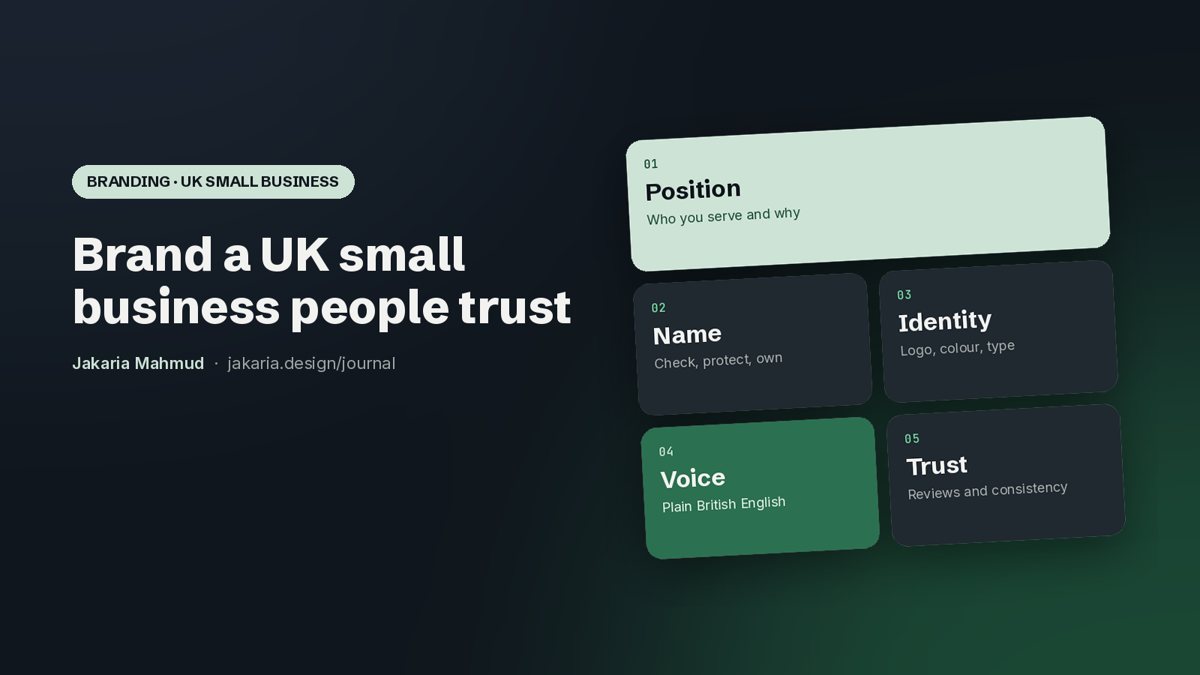
Short answer. To brand a UK small business: 1) define who you serve and why they should choose you, 2) pick a name you can register and protect, 3) design a simple logo system, 4) choose a small colour and type palette, 5) write in plain British English, 6) build a clear website with the legal details shown, 7) set up your Google Business Profile and collect reviews, 8) write short brand guidelines, 9) apply the brand to every touchpoint and 10) protect it with a UK trade mark. Consistency matters more than a big budget.
Why branding matters for UK small businesses
- Trust before price. UK buyers are careful with money and wary of hype. A clear, professional brand makes you feel safe to choose.
- Standing out locally. In most towns there are several businesses offering the same thing. A distinctive name, logo and voice make you the one people remember.
- Charging what you are worth. A brand that looks established supports better prices and better clients.
- Winning bigger work. Tenders, procurement teams and larger clients judge your proposal, website and credentials as a whole.
How to brand a small business in the UK: 10 steps
1. Define who you serve and why they should choose you
Write one sentence: we help [who] get [result] by [how]. Then list the three reasons customers pick you over alternatives. If you are not sure, ask five recent customers. This positioning is the foundation every design decision is judged against.
2. Choose a name you can register and protect
- Limited companies: the name must end in Limited or Ltd, cannot be the same as a name already on the Companies House register and cannot use sensitive words without permission.
- Sole traders and partnerships: you cannot use Ltd, plc or LLP, and sensitive words still need approval.
- Trade marks: search the UK Intellectual Property Office register to make sure the name is not the same as, or very similar to, a registered trade mark in your area of business.
- Online: check the .co.uk or .uk domain and social handles before you commit.
- Practical test: is it easy to say, spell and remember, and will it still fit if you grow into new services or areas?
Since March 2024 Companies House also has stronger powers to reject or change company names that are misleading or intended to facilitate fraud, so choose something clearly your own.
3. Design a simple logo system
Small businesses need a logo that works at the size of a social avatar and on the side of a van. Aim for a primary logo, a compact mark or icon, and one colour versions for light and dark backgrounds. Simple, bold shapes and clear lettering beat detailed illustrations every time. See my logo design service for what a full logo system includes.
4. Choose a small colour and type palette
Pick one main colour, one or two supporting colours and a neutral. Choose one typeface for headings and one for text, and check they are licensed for web and print. Test colour contrast so text stays readable for everyone, including people with low vision.
5. Write in plain British English
UK customers respond to clear, confident and slightly understated language. Say what you do, who it is for and what happens next, without buzzwords. Use British spelling consistently: colour, organisation, centre. Decide two or three words that describe your tone, such as friendly, expert and straightforward, and write everything to match.
6. Build a clear website with the right details
Your website is where most customers check you out. Lead with what you do and who it is for, show real work and reviews, and make it easy to call, book or get a quote. Limited companies must also show certain details, such as the registered company name, company number, place of registration and registered office address, on the website and in business emails and letters. Check the current requirements on GOV.UK.
7. Set up your Google Business Profile and collect reviews
For local businesses, Google is often the first touchpoint. Use the same name, logo, colours, description and opening hours you use everywhere else, add real photos and ask happy customers for reviews. Reply to every review, good or bad, in your brand voice.
8. Write short brand guidelines
Even a two page guide helps: logo dos and don'ts, colour values, fonts, tone of voice and a few examples. It keeps your brand consistent when you hire staff, work with printers or brief a sign maker. More on brand guidelines design.
9. Apply the brand to every touchpoint
List where customers meet you: website, Google profile, social media, email signature, quotes and invoices, proposals, van livery, signage, uniforms and packaging. Update them all so nothing is left in an old style. Consistency is what turns a logo into a recognisable brand.
10. Protect your brand
Once the name and logo are settled, consider a UK trade mark. Since 1 April 2026 an online application to the UK Intellectual Property Office costs £205 for one class and £60 for each extra class. A trade mark attorney can help choose the right classes.
What to prioritise at each budget
| Budget | Prioritise | Leave for later |
|---|---|---|
| Under £1,000 | Positioning sentence, simple logo, colours, fonts, Google profile | Full guidelines, custom photography, signage |
| £1,000 to £5,000 | Logo system, short guidelines, landing page or website refresh, templates | Large rollout, video, packaging range |
| £5,000 to £15,000 | Full identity, guidelines, website, signage and vehicle concepts | Research heavy agency programmes |
For detailed UK price ranges, read how much branding costs in the UK.
Small business branding mistakes to avoid
- Starting with the logo. Without positioning, there is nothing to judge it against.
- Copying a competitor. Looking like the market leader makes you forgettable and can cause legal trouble.
- Too many colours and fonts. Simple systems look more established and are cheaper to apply.
- Not checking the name. Discovering a trade mark conflict after printing everything is expensive.
- Inconsistency. A new logo on the van but the old one on Google tells customers you are disorganised.
- Ignoring reviews. For many UK customers, reviews are part of your brand.
UK small business branding checklist
- One sentence positioning and three reasons to choose you
- Name checked at Companies House, the UKIPO register, domains and social handles
- Logo system with icon and one colour versions
- Small colour and type palette with checked contrast and licences
- Tone of voice in plain British English
- Website with clear offer, real work, reviews and required company details
- Google Business Profile matching the brand, with a review routine
- Short brand guidelines
- Every touchpoint updated, from email signature to van
- UK trade mark considered once the name is settled
Where I fit: Jakaria Mahmud
I build brands with a business mindset and grow businesses with a brand mindset. I work with UK small businesses and startups remotely: your morning is my afternoon, so feedback comes back the same working day, and everything is written in British English.
- Launch, $799 one time: logo and brand starter kit plus one landing page, in about a week.
- Partner, $1,999 per month: full brand identity and guidelines, website UX and UI, product design and development.
- Proof: 80+ clients in 12 countries and a 5.0 rating on Google.
See my brand identity designer for the UK page. If you already have a brand that feels out of date, read the rebranding guide, and for what happens at each stage of a project, the brand identity design process.
The takeaway
A UK small business brand does not need to be expensive to work. It needs to be clear about who it serves, legally sound, simple to recognise and consistent everywhere customers look, from Google to the side of your van. Get those basics right and your brand will do much of your selling for you.
Sources: Business Wales on choosing a business name, Companies House powers over company names and Hindles on UKIPO fees from April 2026. Always check current rules on GOV.UK.
Frequently asked questions
Define who you serve and why they should choose you, pick a name you can register and protect, design a simple logo system, choose a small colour and type palette, write in plain British English, build a clear website, set up your Google Business Profile, write short guidelines, apply the brand everywhere and consider a UK trade mark.
Limited company names must end in Limited or Ltd, cannot be the same as an existing name on the Companies House register and need permission for sensitive words. Sole traders cannot use Ltd, plc or LLP. Always check the name against registered UK trade marks too.
Many start with under £1,000 for positioning, a simple logo and colours, then invest £1,000 to £5,000 for a logo system, guidelines and website refresh as they grow. A full identity with website and signage usually costs £5,000 to £15,000.
It is not required, but it protects your name and logo. Since 1 April 2026 an online UK trade mark application costs £205 for one class and £60 for each extra class.
Limited companies must show details such as the registered company name, company number, place of registration and registered office address. Check the current requirements on GOV.UK.
Yes, if your customers are in the UK. British spelling and plain, understated language feel familiar and trustworthy to UK buyers.
Yes. With a clear process, shared files and calls in UK hours, a senior designer abroad can deliver the same quality as a UK studio, often at a lower cost and with same day feedback.