Branding · 8 min read
Rebranding: when to rebrand your business and how to do it without losing customers
A rebrand can unlock growth or quietly destroy recognition. Here is how to tell if you need a refresh or a full rebrand, the eight step process, and how to launch it without losing customers or Google rankings.

Jakaria MahmudBrand identity and UI/UX designer ·
Most companies think about rebranding at the wrong moment: when the logo feels tired or a competitor launches something shiny. The best rebrands start from a business reason instead. The company has changed, the customers have changed, or the brand is quietly costing deals. Done well, a rebrand makes growth easier. Done badly, it throws away years of recognition in a week.
I am Jakaria Mahmud, a brand identity designer who helps startups and growing companies in the USA, UK, the Gulf and Europe reposition and rebrand. This guide covers how to know if you need a rebrand at all, the difference between a refresh and a full rebrand, the process step by step, how to protect your Google rankings and how to launch without confusing customers.
Short answer. Rebrand when your business has outgrown its brand: you serve new customers, offer something new, merged with another company, or your brand keeps attracting the wrong buyers. If the strategy is still right and only the look is dated, a brand refresh is usually enough. A good rebrand follows eight steps: audit, decide refresh or rebrand, reposition, name check, identity design, guidelines, rollout plan and launch, with SEO redirects and Google Business Profile updates planned before launch day.
What is rebranding?
Rebranding is changing how a business presents itself so it matches what the business has become. It can include a new positioning, messaging, name, logo, visual identity and brand guidelines. The important word is presents: a rebrand changes perception, so it only works when there is a real change underneath it, such as a new audience, offer or ambition.
8 signs you need a rebrand
- You attract the wrong customers. Leads are too small, too price focused or outside your niche, because the brand signals the old version of you.
- You have outgrown the brand. You started as a freelancer or local shop and now sell to larger companies or other countries.
- Your offer changed. New products, a new business model or a pivot that the name and identity no longer describe.
- Merger or acquisition. Two brands need to become one story.
- You look less credible than you are. Prospects compare you with competitors and the brand loses before your product gets a chance.
- Inconsistency everywhere. Every deck, social post and proposal looks different, so the brand never builds recognition.
- Name problems. A trademark conflict, a name that is hard to spell or one that does not work in a new market.
- Entering a new market. Moving into the USA, UK or the Gulf often needs clearer positioning and, in the Gulf, an Arabic version designed together with the English.
A tired logo alone is not one of them. If customers, offer and strategy are unchanged, start with a refresh.
Rebrand vs brand refresh: which do you need?
| Question | Brand refresh | Full rebrand |
|---|---|---|
| What changes? | Logo polish, colours, type, templates | Positioning, messaging, often the name, full identity |
| When is it right? | Strategy is right, the look is dated | The business has changed or the brand attracts the wrong buyers |
| Risk to recognition | Low, customers still recognise you | Higher, needs a planned launch |
| SEO impact | Usually none | Needs redirects if the domain or URLs change |
| Typical timeline | 2 to 4 weeks | 6 to 12 weeks including rollout |
The four types of rebrand
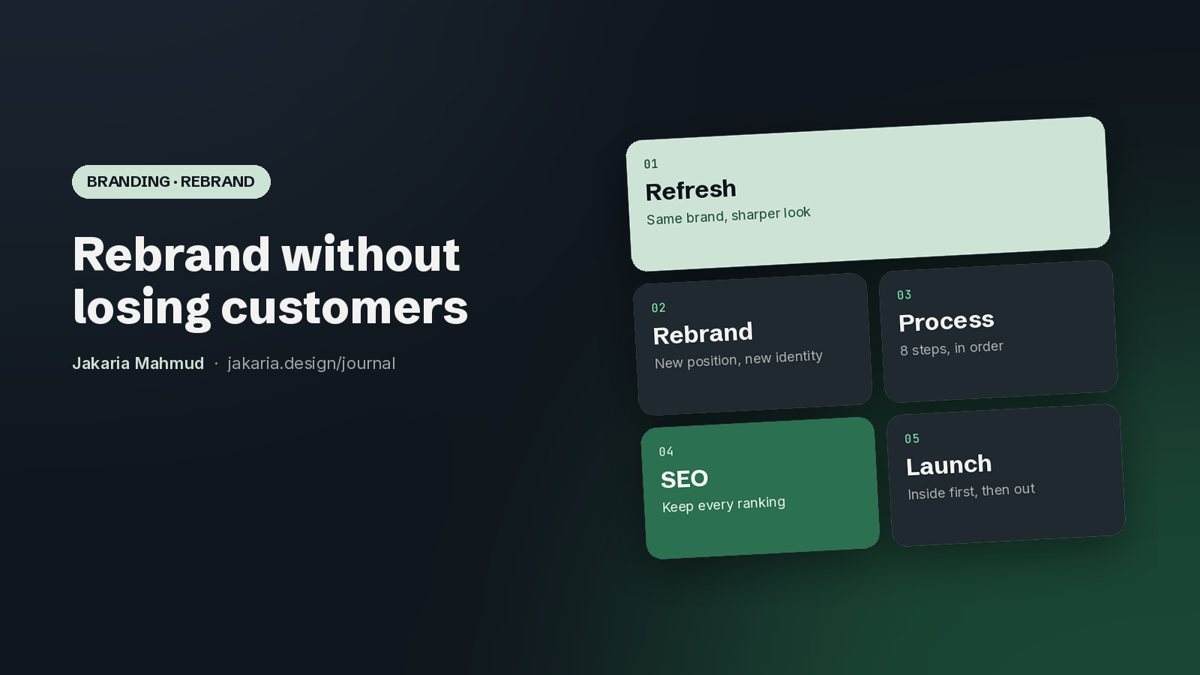
- Refresh: same brand, sharper execution. Updated logo details, colours, type and templates.
- Repositioning: same name, new strategy and messaging, with an identity adjusted to match.
- Full rebrand: new positioning and a new visual identity, keeping the name.
- Rename: a new name as well. The biggest change, with the most legal, SEO and communication work.
The rebranding process in 8 steps
1. Audit what you have
Collect every touchpoint: website, decks, proposals, social, packaging, signage, email. Ask five to ten customers why they chose you and what they would call you to a friend. Keep what is working; the goal is to change only what holds you back.
2. Decide: refresh or rebrand
Use the table above. Be honest about the reason. If you cannot name the business change behind the rebrand, you probably need a refresh.
3. Reposition
Write down who you serve now, what you do better than the alternatives and the one line description you want people to repeat. Approve this before any design work starts.
4. Check the name
If the name changes, run trademark searches in every market you sell in, check domains and social handles, and say it out loud in each language you work in.
5. Design the new identity
Logo system, colour, typography and imagery built from the new positioning. Decide what equity to keep, such as a colour or a shape customers already recognise. Keeping one familiar element makes the transition far smoother. See logo design for what a full logo system includes.
6. Write the brand guidelines
Before launch, put the rules in one place so your team, agencies and printers apply the new brand the same way from day one. More on brand guidelines design.
7. Plan the rollout
List every asset that must change and rank it: website, Google Business Profile, social profiles, email signatures, sales deck and proposals first; signage, vehicles and printed material later.
8. Launch inside first, then outside
Brief your team before customers see anything, so everyone can explain the change. Then launch with a short story: what changed, why, and what stays the same for customers.
For a closer look at each design stage, read the brand identity design process in 7 steps.
How to rebrand without losing Google rankings
This is the part most rebrands forget. A new look does not hurt SEO. A new domain or new page URLs can, if they are not handled properly.
- Keep URLs if you can. If the domain stays the same, keep page addresses unchanged and only update the design and content.
- Use 301 redirects. If the domain or URLs change, redirect every old page to its closest new page, not everything to the home page.
- Tell Google. Use the Change of Address tool in Google Search Console when moving domains and submit the new sitemap.
- Update your Google Business Profile. Name, logo, cover photo and description should match the new brand on launch day.
- Update listings and profiles. LinkedIn, social handles, directories and review sites, so the old and new names connect.
- Explain the change on your site. A short line such as "formerly known as" helps customers and search engines link the two names.
How much does a rebrand cost?
It depends on the scope. A refresh costs less than a full rebrand, and a rename adds legal and rollout costs. The design work itself follows the same ranges as a new brand identity, from a few thousand dollars with a senior independent designer to tens of thousands with larger agencies, plus the cost of updating signage, print and other physical assets. For detailed ranges, see the brand identity design cost guide and what goes into a brand identity design package.
Rebranding mistakes to avoid
- Changing what customers rely on. When Tropicana replaced its familiar orange with a straw by a plain glass of juice on its cartons in early 2009, shoppers struggled to find it on the shelf; sales reportedly fell about 20 percent within two months and the old design was back by spring.
- Rebranding to fix a product problem. A new logo will not save a weak offer.
- Design by committee. Too many decision makers produce a safe brand nobody remembers.
- No rollout plan. Half the touchpoints in the old brand and half in the new one looks worse than either.
- Forgetting SEO. Missing redirects can wipe out years of search traffic.
- Launching quietly. If you do not explain the change, customers may think you were acquired or closed.
Rebranding checklist
- A clear business reason for the rebrand
- Audit of every current touchpoint and customer interviews
- Approved positioning and messaging
- Trademark, domain and social handle checks for any new name
- New logo system and visual identity, keeping valuable equity
- Brand guidelines finished before launch
- Redirect map, new sitemap and Search Console plan
- Google Business Profile, LinkedIn and listings updated on launch day
- Internal briefing, then an external launch story
Where I fit: Jakaria Mahmud
I build brands with a business mindset and grow businesses with a brand mindset. For rebrands that means starting from the business change, keeping what customers already recognise, and planning the launch so nothing is lost along the way, including your search rankings.
- What I deliver: brand audit, repositioning, logo and identity, brand guidelines, rollout plan and the new website in Webflow, Framer or WordPress.
- Pricing: Launch at $799 one time for a starter identity and landing page, or the Partner plan at $1,999 per month for a full rebrand with guidelines and website.
- Proof: 80+ clients in 12 countries and a 5.0 rating on Google.
See the full brand identity design service, or the pages for the USA, UK and Dubai and the UAE.
The takeaway
Rebrand when the business has changed, refresh when only the look has. Start with positioning, keep the equity customers already trust, write the guidelines before launch and protect your search rankings with a proper redirect and profile plan. That is how a rebrand adds momentum instead of costing it.
Further reading: Works Design Group on refresh vs rebrand and Packaging Digest on the Tropicana redesign.
Frequently asked questions
Rebranding is changing how a business presents itself, including positioning, messaging and often the name, logo and visual identity, so the brand matches what the business has become.
When the business has outgrown its brand: new customers or markets, a new offer or business model, a merger, a name problem, or a brand that keeps attracting the wrong buyers. If only the look is dated, a brand refresh is usually enough.
A brand refresh updates the visual execution, such as logo details, colours and templates, while keeping the strategy. A rebrand changes the positioning and messaging and usually the full identity, sometimes the name.
A refresh usually takes two to four weeks. A full rebrand, including positioning, identity, guidelines and rollout, usually takes six to twelve weeks.
A new design does not. A new domain or new URLs can, unless every old page is 301 redirected to its closest new page, the new sitemap is submitted and Google Search Console's Change of Address tool is used for domain moves.
It depends on the scope. Design follows the same ranges as a new brand identity, from a few thousand dollars with a senior independent designer to tens of thousands with large agencies, plus costs to update signage and printed material.
Keep what customers already recognise if it still fits, such as a colour or shape. Keeping one familiar element makes the change easier to accept and protects recognition.