Branding · 8 min read
Small business branding in the USA: a step by step guide to building a brand customers trust
You do not need an agency budget to look established in the US market. Here is a ten step guide to branding a small business in the USA, from positioning and name checks to USPTO trademarks, Google reviews, FTC rules and the details customers notice.

Jakaria MahmudBrand identity and UI/UX designer ·
American customers compare fast. Before they call, they check your Google listing, scroll your website on their phone, look at your reviews and decide whether you look like a business they can trust with their money. For a small business, that first impression often decides the sale. A strong brand does not need a big budget. It needs to be clear, consistent and believable everywhere people meet you.
I am Jakaria Mahmud, a brand strategist and brand identity designer working with founders and small teams across the USA. This guide walks through the ten steps I use to brand a small business, with the US specific details generic guides skip: name checks with your state, USPTO trademark costs, what your website should show and the FTC rules on reviews.
Short answer. To brand a small business in the USA: define who you serve and why they should choose you, check your name with your Secretary of State and the USPTO, design a simple logo with a small color and type system, write in a direct and specific voice, build a fast mobile website, set up your Google Business Profile, collect real reviews, and keep everything consistent. A federal trademark application starts at $350 per class of goods or services at the USPTO.
Why branding matters for US small businesses
- Customers check you online first. Your Google listing, website and reviews are usually the first thing a buyer sees, even for a local service.
- Competition is national. A small firm in Ohio competes with online businesses from every state. A clear brand is how you stop being compared on price alone.
- Trust drives the decision. People pay more and refer more when a business looks established and consistent.
- Your brand is an asset. A recognizable, protected brand adds value if you ever raise money, franchise or sell.
How to brand a small business in the USA: 10 steps
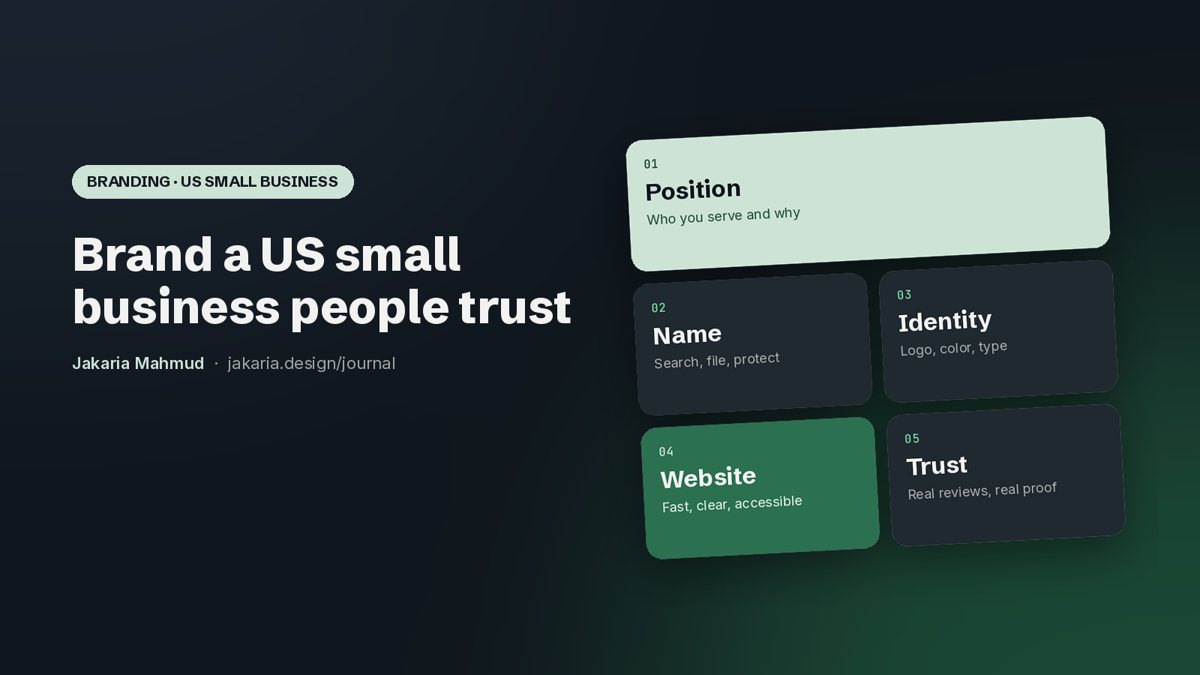
1. Define your position
Write one sentence: who you serve, the problem you solve and why you are the better choice. "Bookkeeping for restaurants in Chicago that closes your month in five days" is a position. "Quality service at fair prices" is not. Everything else in your brand follows from this line. For the deeper version, read what a brand strategist does.
2. Know your customer
Talk to five recent customers. Ask why they chose you, what they compared you with and what almost stopped them buying. Use their exact words on your website. They will sound more convincing than anything a copywriter invents.
3. Check and protect your name
- State registration: check your Secretary of State business database before forming an LLC or corporation. If you trade under a different name, most states or counties require a DBA (doing business as) filing.
- Federal trademark: search the USPTO trademark database for similar names in your industry. Since January 2025 the USPTO base application fee is $350 per class, with surcharges of $100 per class for insufficient information and $200 per class for free form descriptions.
- Online: secure the .com domain if you can, plus matching social handles.
Registering an LLC name does not give you trademark rights across the country. If the brand matters to you, speak with a trademark attorney before you invest in signage and print.
4. Design a logo that works small
Your logo will live on a phone screen, a Google listing, a favicon and a truck. Keep it simple, legible and distinctive in your category. Most small businesses do best with a clean wordmark plus a compact symbol for social avatars. See the logo design service for how I approach it.
5. Choose colors and type
Pick one main color you can own, one or two supporting colors and a neutral. Choose one typeface for headings and one for text. Check contrast so text is easy to read for everyone. Fewer choices make it much easier to stay consistent.
6. Find your voice
American buyers respond to direct, specific and benefit led language. Say what you do, for whom and what result they get, in plain words. Show real prices or ranges where you can, and keep claims you can back up.
7. Build a fast, clear website
- A headline that says what you do and who it is for
- Services, prices or price ranges, and the area you serve
- Real photos, real reviews and real case studies
- A clear call to action on every page, such as call, book or get a quote
- Fast loading on mobile and accessible design, with good contrast, alt text and keyboard friendly forms
8. Set up your Google Business Profile
For local and service businesses, your Google Business Profile is often seen more than your website. Choose the right primary category, add your service area, hours, real photos and services, and post updates regularly. Keep your name, address and phone exactly the same on your website and every directory.
9. Collect real reviews
Ask every happy customer for a review, with a direct link. Never buy, write or gate reviews. The FTC's rule on consumer reviews and testimonials bans fake reviews and undisclosed insider reviews, and civil penalties can apply. Real reviews, including a few imperfect ones, look more trustworthy than a perfect wall of five stars.
10. Stay consistent
Put the logo, colors, fonts and tone into a simple one page guide, and use templates for social posts, proposals and invoices. Consistency is what turns a logo into a brand people recognize. For bigger teams, brand guidelines make this automatic.
What to prioritize at each budget
| Budget | Focus on | Skip for now |
|---|---|---|
| Under $1,000 | Positioning line, a clean logo, colors, a one page website and a Google Business Profile | Long brand books and paid ads |
| $1,000 to $5,000 | Custom logo system, a multi page website, templates and a trademark application | Expensive photoshoots before the website works |
| $5,000 to $20,000 | Full brand identity, brand guidelines, professional photography and content | Rebranding again before you have tested this one |
| $20,000+ | Research led strategy, full identity, website, product UI and launch campaign | Designing for awards instead of customers |
For detailed US pricing, read how much brand identity design costs in the USA. If you are choosing between agencies and freelancers, see how US companies choose a branding partner.
Small business branding mistakes to avoid
- Designing before deciding. A logo cannot fix an unclear position.
- Skipping the name check. Rebranding after a trademark dispute costs far more than a search.
- Copying the market leader. Looking like the biggest competitor makes you the cheaper copy.
- Too many fonts and colors. It looks amateur and breaks consistency.
- Fake or bought reviews. A legal risk under FTC rules and a trust risk with customers.
- Ignoring mobile. Most people will see your brand on a phone first.
US small business branding checklist
- One sentence positioning statement
- Name checked with your Secretary of State and the USPTO
- DBA filed if you trade under a different name
- Domain and social handles secured
- Logo, compact mark and favicon
- Color palette and two typefaces with good contrast
- Fast, accessible, mobile friendly website with clear calls to action
- Google Business Profile complete with categories, services and photos
- A simple, honest way to collect real reviews
- One page brand guide and templates
Where I fit: Jakaria Mahmud
I build brands with a business mindset and grow businesses with a brand mindset. For US small businesses that means positioning first, a logo and identity that look established on every screen, and a website built to turn visits into calls and bookings.
- What I deliver: positioning, logo, brand identity, brand guidelines and a website in Webflow, Framer or WordPress.
- Pricing: the Launch plan at $799 one time covers a positioning brief, logo, brand starter kit and landing page. The Partner plan at $1,999 per month covers full strategy, identity, guidelines and website.
- Proof: 80+ clients in 12 countries, $1.4M+ in revenue impacted and a 5.0 rating on Google.
- Working hours: calls in US time zones, from New York to California.
See the brand identity designer for the USA page, the full brand identity design service, or the branding guide for Texas. Running a fintech? Read fintech branding.
The takeaway
A small business brand in the USA wins on clarity, consistency and trust, not budget. Decide who you serve, protect your name, keep the identity simple, make the website fast and honest, and let real reviews do the selling. Start small, stay consistent and invest more as the business grows.
Further reading: USPTO trademark basics, Fish & Richardson on the 2025 USPTO fees and the FTC consumer reviews and testimonials rule.
Frequently asked questions
Define who you serve and why they should choose you, check your name with your Secretary of State and the USPTO, design a simple logo with a small color and type system, write in a direct voice, build a fast mobile website, set up your Google Business Profile, collect real reviews and stay consistent everywhere.
A basic starter brand can cost under $1,000, a custom logo system and website usually costs $1,000 to $5,000, and a full brand identity with guidelines usually costs $5,000 to $20,000 or more. Jakaria Mahmud's Launch plan is $799 one time.
Since January 2025 the USPTO base application fee is $350 per class of goods or services, with possible surcharges of $100 per class for insufficient information and $200 per class for free form descriptions. Attorney fees are extra.
No. Registering an LLC reserves the name with your state for company registration, but it does not give nationwide trademark rights. A federal trademark registration with the USPTO gives much stronger protection.
If you trade under a name that is different from your legal business name, most states or counties require a DBA filing, also called an assumed or fictitious business name.
No. The FTC rule on consumer reviews and testimonials bans fake reviews, bought positive reviews and undisclosed reviews from insiders. Ask real customers for honest reviews instead.
Yes. Many US small businesses work with remote designers. Jakaria Mahmud works with US clients remotely, with calls in US time zones, fixed prices in US dollars and full ownership of every file.