Branding · 10 min read
Best brand design in the USA: how SaaS, AI, startup, logistics and construction companies choose a branding partner
The best brand design in the USA is not the agency with the biggest name. It is the partner who can turn your strategy into a brand buyers trust. Here is how US founders choose, industry by industry.

Jakaria MahmudBrand identity and UI/UX designer ·
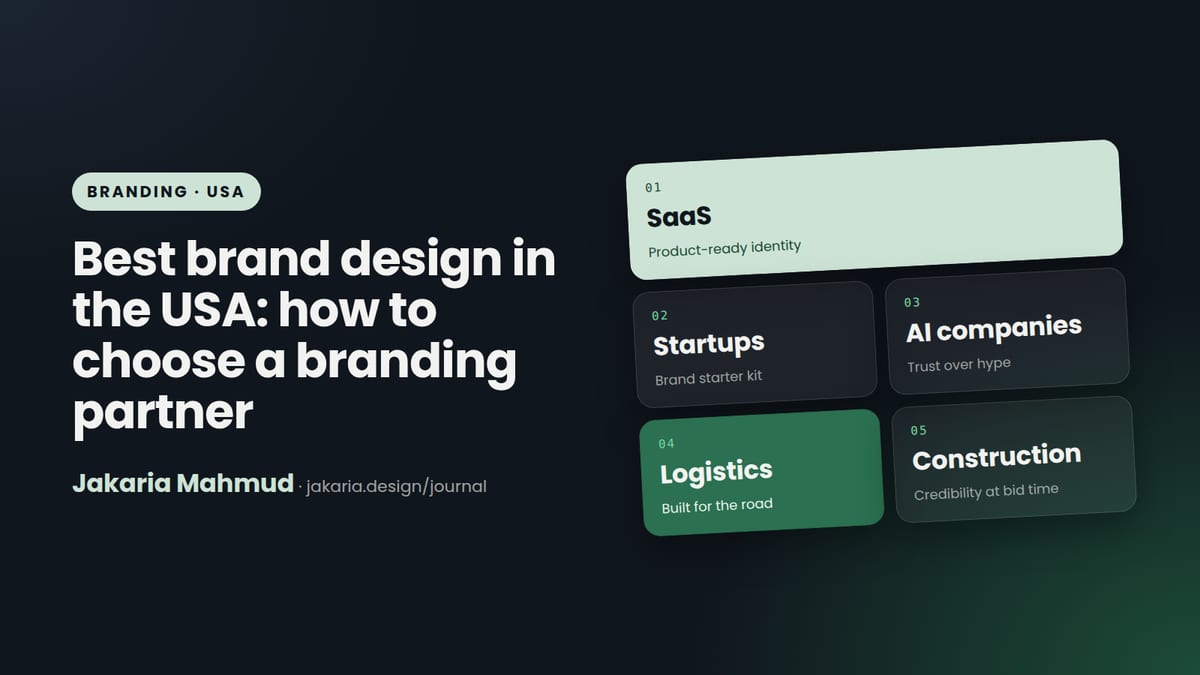
Search for the best brand design in the USA and you get lists of famous agencies, award winners and logo galleries. Useful for inspiration, not much use for a decision. A SaaS founder in Austin, an AI team in San Francisco, a freight company in Chicago and a general contractor in Texas need very different things from a brand, and "best" only means something against what your buyers need to believe before they say yes.
I am Jakaria Mahmud, a brand identity and UI/UX designer. I lead sales and business development at Wolf Pixel, a company based in Louisiana, and I have worked with more than 80 clients across 12 countries. That mix of sales and design is the lens for this guide: what great brand design looks like for US companies in 2026, how it differs by industry, what it costs, and how to choose a partner without guessing.
What "best brand design" actually means
A brand is the promise a company makes and the proof that it keeps it. Brand design is how that promise looks, sounds and feels at every point where a buyer meets you: the homepage, the pitch deck, the product, the proposal, the truck on the road or the sign on the job site. The best brand design does four jobs at once.
- It is built on positioning. Who you are for, what they get and why you win are decided in writing before anything is drawn. Strategy first is what separates brand identity design from decoration.
- It works as a system, not a logo. Logo suite, colour, typography, visual language and guidelines that let anyone on your team produce on-brand work. (Here is what a complete brand identity package should include.)
- It is ready for sales. The brand has to survive a sales deck, a proposal, a demo and a skeptical procurement team, not only a Dribbble shot.
- It is proven in the product and on the website. For software companies especially, the brand lives in the interface. If it breaks the moment it meets a dashboard, it was never finished.
A simple test. Show your homepage to someone in your market for five seconds. If they cannot say what you do, who it is for and why it is credible, the brand is not doing its job yet, however good the logo looks.
Your three real options in the US market
Most US companies end up choosing between three kinds of branding partner. None is best for everyone; each is best for a certain stage and budget.
| Option | Best for | Watch out for |
|---|---|---|
| Large US branding agency | Established companies, big rebrands, multi-market launches with large teams | Long timelines, senior people selling and junior people delivering, budgets that early companies cannot justify |
| Boutique studio or US freelancer | Focused identity projects with a clear brief | Strategy and website or product work often sit outside scope, so the brand stops at the guidelines PDF |
| Remote senior designer or studio | Startups, SaaS and growing B2B companies that want strategy, identity, website and product in one team | Check time zone overlap, communication habits and ownership of files before you sign |
The question is not which one is most famous. It is which one will still be accountable when the brand meets your website, your product and your pipeline.
Brand design by industry
The fundamentals are the same everywhere. What changes is what the buyer is afraid of and what the brand has to prove. These are the industries I work with most, and what the best brand design looks like in each.
SaaS companies
SaaS buyers compare you in tabs. They land on your homepage, open two competitors, skim pricing and decide in minutes whether to book a demo. Your brand has to make a complex product feel simple and a young company feel dependable.
- A clear category and a one line value proposition before any visual work.
- An identity designed with UI in mind: colours that work for charts and states, type that reads at 13px in a table, icons that scale.
- A design system shared by marketing site and product, so the brand does not change the moment someone logs in.
This is where brand identity and UI/UX design have to be one job. On Fintrack, a fintech dashboard, the onboarding redesign took task completion from 50% to 95%; the same principle applies to the brand around it. (More in SaaS onboarding UX: seven fixes.)
Startup founders (pre-seed to Series A)
Early founders need a brand that raises trust fast without burning runway. Investors, first hires and first customers all judge the company by the deck and the website long before revenue can speak for it.
- Start with a brand starter kit: positioning, logo suite, colour, type and one strong landing page.
- Design the pitch deck in the brand. It is often the most important piece of design a startup owns.
- Keep the system flexible, because the product and the story will change after the next round.
A strong early brand is not expensive decoration. It is the fastest way to look as serious as the product you are building.
AI companies
AI is the most crowded brand category of 2026. Gradient orbs, sparkles and "intelligent" in the tagline make most AI companies look interchangeable, and buyers have learned to distrust vague promises.
- Lead with the job you do and the outcome, not the model. Specific beats futuristic.
- Design for trust: clear data and privacy language, visible human oversight, real product screens instead of abstract art.
- Build a visual language that can explain things (diagrams, flows, before and after) because AI products need more explanation than most.
For agentic AI in particular, the brand has to show control as much as capability. Buyers want to know what the system does on its own, where a person steps in, and how they can check the result.
Logistics companies
Logistics brands are judged on reliability. Shippers, brokers and carriers want to know you will pick up, track, communicate and deliver, every time. The brand has to look operationally serious and work in the physical world.
- A mark that stays legible on trucks, trailers, uniforms, labels and app icons, at distance and at small sizes.
- A colour system that holds up in outdoor, printed and dashboard use, including status colours for tracking interfaces.
- Messaging built around proof: coverage, on-time performance, safety and service, stated plainly.
Many logistics companies also run a customer portal or tracking dashboard, so the brand and the UI should be designed together from the start.
Construction companies
In construction, brand is credibility at bid time. Developers, owners and procurement teams compare contractors on safety, track record and professionalism, and the website, proposal and site signage all send a signal before anyone reads the numbers.
- A confident, durable identity that works on hoardings, vehicles, PPE, signage and proposals, not only on screen.
- A project portfolio designed as proof: scope, sector, value range and outcome for each job.
- Proposal and capability statement templates in the brand, because that is where most construction work is won.
The full playbook is here: the best brand identity for construction companies.
How to choose a brand design partner: 10 questions
- How do you handle positioning and messaging before design starts?
- Can I see identities you designed applied to real websites, decks and products, not only logo boards?
- Have you worked in my industry, or with buyers like mine?
- Who exactly will work on my project, and who do I talk to every week?
- What is the fixed scope, timeline and price, and what happens if we need changes?
- Will the brand be applied to my website and, if relevant, my product UI?
- What do the guidelines include, and how will my team use them?
- Do I own all source files, and are font licences covered?
- How do you measure whether the new brand works?
- How will we work across time zones, and how fast do you reply?
A partner who answers these clearly and in writing is usually a partner who will deliver clearly too.
What brand design costs in the USA
Prices vary widely because scope varies widely. Established US branding agencies often quote tens of thousands of dollars for a full identity, and more for multi-market rebrands. Freelancers range from a few hundred dollars for a logo to agency level fees for senior specialists. What you should compare is not the headline price but what is included: strategy, the full system, guidelines, applications and ownership.
As a transparent reference, my own pricing is fixed. The Launch plan, a logo and brand starter kit with one landing page, is $799. Full brand identity with guidelines, website and product design sits in the Partner plan at $1,999 per month, and the Growth plan at $3,999 per month adds sales systems and paid growth. Every plan starts with a written brief, so you know exactly what you are buying.
Why many US founders work with a remote brand partner
US companies have worked with remote design partners for years, and for good reasons: senior talent without senior agency overhead, one team for brand, website and product, and asynchronous work that keeps moving while you sleep. The risks are real too: slow replies, unclear ownership and briefs lost in translation.
The fix is process, not location. Weekly written updates, a shared Figma, clear owners, fixed scope and a partner who understands how your buyers make decisions. Ask for all of it upfront.
Where I fit: Jakaria Mahmud
I am a brand identity and UI/UX designer who came to design from the sales side. Before and alongside design work I have led sales and business development: today as Head of Sales and Business Development at Wolf Pixel in Louisiana, and before that as a Senior Business Development Specialist at Nurency and Antopolis. I build brands with a business mindset and grow businesses with a brand mindset.
- Industries: SaaS, B2B, fintech, healthcare, agentic AI, logistics, construction, ecommerce and super apps.
- Work: brand strategy and positioning, brand identity design, brand guidelines, pitch decks, websites in Webflow, Framer or WordPress, and product UI in Figma.
- Proof: 80+ clients in 12 countries, $1.4M+ in revenue impacted, a 5.0 rating on Google, and a LinkedIn recommendation from a Senior Product Designer at IBM.
If you are a US founder deciding how to brand or rebrand, see the brand identity design service, or book a free 30 minute brand audit. You will leave with a plan whether we work together or not.
Hiring from a specific market? See brand identity designer for the USA, the UK or every market I work with.
The takeaway
The best brand design in the USA is not a list of famous names. It is the partner who starts with positioning, designs a system instead of a symbol, proves it on your website and product, understands your industry's buyers and hands you everything you paid for. Choose on those five things and the brand will pay for itself in the conversations it wins.
Frequently asked questions
There is no single best agency for every company. Large US agencies suit big rebrands, boutique studios suit focused identity projects, and remote senior designers suit startups and SaaS companies that want strategy, identity, website and product in one team. Choose the partner whose process, industry experience and scope fit your stage.
Established US branding agencies often charge tens of thousands of dollars for a full identity, while freelancers range from a few hundred dollars upward. Compare what is included, such as strategy, guidelines, applications and file ownership, rather than the headline price. Jakaria Mahmud's Launch plan starts at a fixed $799.
Look for someone who designs the brand and the product interface together, starts with positioning, and can show identities applied to real websites and dashboards. For AI companies, the brand should build trust with specific outcomes and clear language rather than generic futuristic visuals.
Yes, if the process is clear: fixed scope, written updates, a shared Figma file, agreed response times and full ownership of source files. Many US startups work with remote brand and product designers for senior quality without agency overhead.
Jakaria Mahmud is a brand identity and UI/UX designer and Head of Sales and Business Development at Wolf Pixel. He has worked with 80+ clients across 12 countries in SaaS, AI, logistics, construction, fintech and healthcare, combining brand strategy, design and sales.