Branding · 10 min read
The best brand identity for construction companies: how to win trust, bids and talent
In construction, your brand is judged at bid time, on the road and on the job site. Here is what the best construction brand identities include, how to build one and how to roll it out without waste.

Jakaria MahmudBrand identity and UI/UX designer ·
In construction, people judge your company long before they read your numbers. A developer skims your proposal cover, an owner drives past your hoarding, a site manager sees your trucks arrive, a skilled worker checks your website before applying. Each of those moments either says "serious, safe, reliable" or it does not. That is what a construction brand identity is for.
I am Jakaria Mahmud, a brand identity and UI/UX designer, and construction is one of the industries I work with. This guide explains what the best brand identity for a construction company includes, how it differs by sector, how to build it and how to roll it out across vehicles, sites and documents without wasting money.
Key takeaways. A construction brand has to work in the physical world first: on trucks, hoardings, hard hats and printed proposals, not only on screen. The best identities are built on clear positioning, use a small durable system of logo, colour and type, prove credibility with real project evidence, and are rolled out in phases that follow your asset replacement cycle.
Why brand identity matters for construction companies
Most construction work is won through tenders, prequalification, referrals and relationships. Brand does not replace any of those, but it quietly improves the odds in each one.
- Winning bids. When prices and programmes are close, the contractor who looks more organised and more credible is easier to choose and easier to defend internally.
- Client confidence. A consistent identity signals process and control. Inconsistent logos, mismatched vehicles and improvised documents suggest the opposite.
- Recruitment. Skilled trades and project managers compare employers too. A strong brand makes your company look like a place people want to build a career.
- Safety culture. A clear, respected identity on PPE, signage and site inductions reinforces standards on site.
- Referrals and repeat work. A memorable name and mark make it easier for satisfied clients to recommend you by name.
What the best construction brand identities have in common
- Credible before creative. They look established and dependable. Clever ideas are welcome, but never at the cost of seriousness.
- Durable and legible. The mark reads at 50 metres on a hoarding and at 20 millimetres on a hard hat, in one colour and in embroidery.
- Consistent across every site. The same system on every vehicle, sign and document, so the company looks the same size everywhere it works.
- Proof led. Project photography, sectors, values and safety records are presented as evidence, not decoration.
- Recruitment ready. The brand speaks to future employees as clearly as it speaks to clients.
- Scalable. It can grow into new divisions, regions or services without a rebrand every few years.
The 10 elements of a construction company brand identity
1. Positioning and messaging
Before any design, decide who you build for, what you are best at and why clients should choose you. A commercial general contractor known for complex fit-outs on tight programmes needs a very different message from a family-run residential builder. Write it down as a short positioning statement and three or four message pillars such as safety, delivery, quality and partnership, each backed by a proof point.
2. Name and tagline
Many construction companies carry a founder's name, which is an asset for trust. The work is making it read clearly and pairing it with a descriptor that says what you do, for example "Builders", "Construction" or "Civil Engineering", so nobody has to guess.
3. Logo suite built for the physical world
A primary logo, a compact version and a symbol or monogram. Each must work in one colour, reversed out of dark backgrounds, as cut vinyl and as embroidery. Avoid fine lines, tiny details and gradients that disappear on a hard hat sticker or a high-vis vest.
4. Colour palette
Choose one strong primary colour and a restrained set of neutrals. Specify it for screen (HEX, RGB), print (CMYK, Pantone) and vinyl or paint references for vehicles and signage. Be careful with safety colours: if your brand colour is the same yellow or orange as warning signage, it can compete with safety messages on site. A distinct brand colour, with safety colours used only for safety, is usually clearer.
5. Typography
A robust typeface for headlines that stays legible at distance, and a clean text face for proposals and reports. Condensed and heavy weights work well on signage and vehicles; make sure licences cover print, web and signage use.
6. Photography and project imagery
Your projects are your best marketing. Define how sites and finished work are photographed: real people, real equipment, correct PPE, consistent angles and lighting. A small library of strong project photography does more for credibility than any stock image.
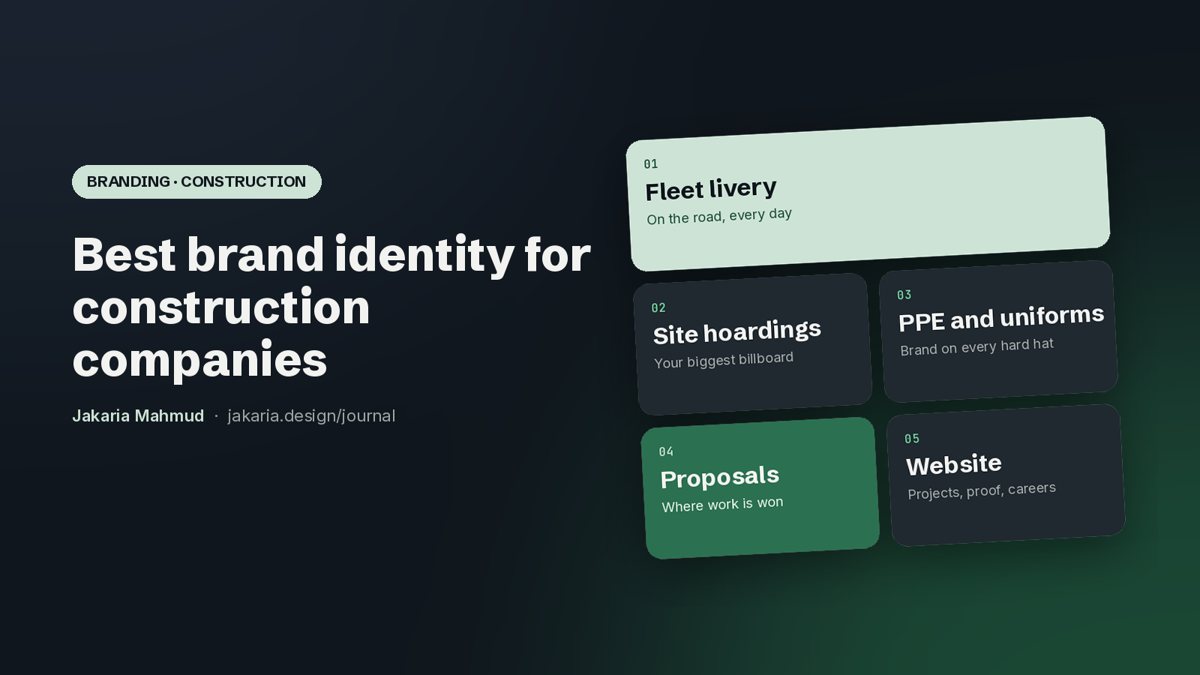
7. Fleet and equipment livery
Vehicles are moving billboards. Design a livery system with simple placement rules for vans, trucks, plant and trailers: logo, website and phone on the sides, a clear mark on the rear. Keep it simple so it scales across different vehicle shapes and stays affordable to apply.
8. Site hoardings and signage
A hoarding is the largest brand asset you own, often seen by thousands of people a day. Create templates for hoardings, site boards, directional and safety signage, with space for project information, partners and a visual of the finished building.
9. PPE, uniforms and site essentials
Hard hats, high-vis vests, workwear, site office stickers and induction materials. The rules here are practical: size, placement, one colour application and compliance with safety standards first.
10. Proposals, capability statements and website
This is where most construction work is won. Branded templates for tenders, capability statements, method statements and case studies make every submission look consistent and save hours per bid. The website should present sectors, a project portfolio with scope and outcome for each job, safety and accreditation credentials, and a careers section. (Here is why most business websites do not convert, and how to fix it.)
Construction branding by sector
| Sector | What buyers need to believe | Brand priorities |
|---|---|---|
| General contractors | You deliver complex projects safely, on programme and on budget | Proposal and capability templates, project portfolio, hoardings, safety credentials |
| Residential builders | You are trustworthy with people's homes and money | Warm but professional tone, reviews, clear process, website and signage at the plot |
| Civil and infrastructure | You have the capacity, plant and compliance for public work | Fleet and plant livery, prequalification documents, community and stakeholder communication |
| Specialty trades | You are the specialist contractors can rely on | Vans and uniforms, a clear specialism in the name or descriptor, fast quote and contact paths |
| Design-build and developers | You can take a project from idea to handover | Premium visuals and renders, investor decks, project microsites and sales suites |
How to build a construction brand identity, step by step
- Audit. Collect every place the brand appears today: vehicles, signage, PPE, proposals, website, social. Talk to a few clients and site staff about how they see the company.
- Positioning. Agree who you build for, your strengths and your message pillars, in writing, before design starts.
- Identity concepts on real applications. Review each direction on a truck, a hoarding, a hard hat, a proposal cover and the homepage, not floating on a white page.
- System and guidelines. Refine the chosen direction into a full system with clear, practical guidelines that suppliers such as sign makers and uniform printers can follow.
- Templates and rollout. Produce proposal, capability and signage templates, then roll the brand out in phases.
How to roll out a rebrand without wasting money
Construction brands live on expensive physical assets, so a smart rollout matters as much as the design.
- Phase 1, digital and documents: website, email signatures, proposal and capability templates, social profiles. Fast, cheap and seen by every client.
- Phase 2, new sites: every new hoarding and site board uses the new system from day one.
- Phase 3, fleet and PPE: apply the new livery as vehicles are replaced or re-leased, and the new PPE branding as stock is reordered.
This keeps the transition affordable while the brand becomes visible where it matters most: at bid time.
What construction branding costs and how long it takes
Costs depend on scope. A logo and brand starter kit for a small builder can take about a week. A full identity with guidelines, proposal templates, signage and vehicle designs and a new website usually takes several weeks, and most of the variation comes from feedback speed and the number of applications. Physical production, such as vehicle wraps, hoarding printing and PPE, is budgeted separately with your suppliers.
My own pricing is fixed and transparent: the Launch plan, a logo and brand starter kit with one landing page, is $799, and full brand identity with guidelines, website and ongoing design sits in the Partner plan at $1,999 per month. Whoever you hire, insist on a fixed scope and a written brief.
7 construction branding mistakes to avoid
- Designing for the screen only. If it fails on a hard hat or a truck, it fails.
- Using safety colours as brand colours without rules. Your brand should never be confused with a warning sign.
- Too much detail in the logo. Fine lines disappear in embroidery and at distance.
- Stock photography instead of real projects. Clients want to see what you actually built.
- No proposal templates. Every bid ends up looking different, and hours are lost formatting.
- Guidelines nobody can use. Sign makers and uniform suppliers need simple, practical specifications.
- Rebranding everything at once. A phased rollout saves money and keeps quality high.
Construction brand identity checklist
- Positioning statement and message pillars with proof points
- Logo suite in colour, one colour, reversed, vinyl and embroidery versions
- Colour palette with HEX, RGB, CMYK, Pantone and vinyl references
- Typography licensed for print, web and signage
- Project photography guidelines and a starter library
- Fleet, plant and trailer livery rules
- Hoarding, site board and signage templates
- PPE, uniform and site essentials specifications
- Proposal, capability statement and case study templates
- Website with sectors, portfolio, credentials and careers
- Practical brand guidelines for staff and suppliers
- A phased rollout plan tied to asset replacement
Where I fit: Jakaria Mahmud
I build brands with a business mindset. Before and alongside design work I have led sales and business development, today as Head of Sales and Business Development at Wolf Pixel, so I design construction brands around the moments where work is actually won: the tender, the proposal, the site visit and the first call.
- What I deliver: positioning, brand identity design, brand guidelines, proposal and capability templates, signage and fleet concepts, and websites in Webflow, Framer or WordPress.
- Industries: construction, logistics, SaaS, agentic AI, fintech, healthcare and B2B services.
- Proof: 80+ clients in 12 countries, $1.4M+ in revenue impacted and a 5.0 rating on Google.
If you run a construction company and want a brand that wins trust at bid time, see the brand identity design service or book a free 30 minute brand audit. For how brand needs differ across other industries, read how SaaS, AI, startup, logistics and construction companies choose a branding partner.
Building in the Gulf? See brand identity design for Saudi Arabia, Dubai and the UAE and Qatar, or read the Dubai brand identity guide.
The takeaway
The best brand identity for a construction company is not the flashiest logo. It is a clear position, a durable system that works on trucks, hoardings and hard hats, proposals that look as organised as your sites, and real project proof, rolled out in a way that respects your budget. Build that, and your brand starts winning work before you walk into the room.
Frequently asked questions
A good construction brand identity is built on clear positioning and uses a simple, durable logo, colour and type system that works on vehicles, hoardings, PPE and proposals as well as on screen. It presents real project proof and is documented in practical guidelines that staff and suppliers can follow.
It should be simple, bold and legible at distance and at small sizes, work in one colour, reversed, as vinyl and as embroidery, and avoid fine details and gradients. Many strong construction logos pair a clear wordmark with a compact symbol or monogram for hard hats and app icons.
It depends on scope. A logo and brand starter kit can be a small fixed fee, while a full identity with guidelines, proposal templates, signage, fleet designs and a website costs more. Physical production such as vehicle wraps and hoardings is budgeted separately. Jakaria Mahmud's Launch plan starts at a fixed $799.
It can, but with clear rules. If the brand colour matches warning signage, it can compete with safety messages on site. Many contractors choose a distinct brand colour and reserve safety colours for safety communication only.
In phases: first the website, documents and proposal templates, then every new site hoarding and board, and finally vehicles and PPE as they are replaced or reordered. This keeps costs under control while the new brand appears where clients see it most.