Branding · 10 min read
Branding in Texas: how Austin, Dallas, Houston and San Antonio companies build brands that win
Texas is huge, fast growing and fiercely competitive. Here is how Austin tech startups, Dallas service firms, Houston energy companies and San Antonio businesses build brand identities that win customers.

Jakaria MahmudBrand identity and UI/UX designer ·
Texas is one of the fastest growing business markets in the United States. Companies keep moving their headquarters here, Austin keeps producing startups, Houston runs on energy and healthcare, and Dallas and Fort Worth have become home to some of the largest companies in the country. More competitors means buyers decide faster, and your brand is often the first thing they judge.
I am Jakaria Mahmud, a brand identity designer who works with founders and teams across the USA, including Texas. This guide covers what Texas buyers expect, how branding priorities change from Austin to Houston, how the approach differs by industry, how to plan for English and Spanish, what brand identity design costs and how to choose the right partner.
Key takeaways. Pick a clear niche inside a very big market, design a bold identity that works on trucks, job sites and screens, plan for English and Spanish from the start, match the brand to your city and industry, and put everything into guidelines so every location and vendor applies it the same way.
Why branding matters more in Texas
- A crowded, fast growing market. New companies and relocated headquarters arrive every year. Buyers have more choice, so a vague or dated brand gets skipped.
- Big distances, many touchpoints. Customers often meet you on a truck, a yard sign, a job site or a Google listing before they visit your website. The identity has to work on all of them.
- Local pride. Texans respond to brands that feel confident and rooted in the state, as long as it feels earned rather than a costume.
- A diverse audience. Texas is home to a large Spanish speaking population, so many brands need to communicate clearly in English and Spanish.
- National ambition. Many Texas companies sell across the US. The brand has to look credible in Houston and in New York.
What Texas buyers expect from a brand
- Straight talk. Say what you do, where you do it and why you are the right choice. Clever wordplay loses to clarity.
- Confidence. Bold typography, strong colour and a brand that looks like it will still be here in ten years.
- Proof. Reviews, project photos, certifications and named clients, presented as part of the brand.
- Local presence. Service areas, real addresses and people customers can call.
- Consistency across locations. Growing companies often run several offices or crews. The brand has to look the same in every city.
Branding priorities by Texas city
Every major Texas metro has its own business culture, so the same brand can land differently in each:
| City | Business landscape | Brand priorities |
|---|---|---|
| Austin | Tech startups, SaaS, creative and consumer brands | Product ready identity, pitch deck, website that converts, personality without hype |
| Dallas and Fort Worth | Corporate headquarters, finance, real estate, professional services | Polished, established identity, proposals and decks, LinkedIn presence |
| Houston | Energy, healthcare, port and logistics, industrial services | Credible technical brand, safety and proof, capability statements, fleet and site branding |
| San Antonio | Healthcare, cybersecurity, tourism, family businesses | Trust and warmth, bilingual materials, strong local reputation |
| Statewide trades | Construction, home services, roofing, HVAC | Bold logo for trucks and yard signs, Google profile, reviews, quote flow |
Brand identity by industry in Texas
SaaS and tech startups
Austin founders compete for customers, talent and investors at the same time. The identity needs to work inside the product, on the website and in the deck. Lead with a clear outcome, keep the visual system simple enough to scale, and make the landing page do the selling. My guide to SaaS and AI brand design in the USA goes deeper.
Energy and clean energy
Texas leads the country in wind power and is growing fast in solar and storage, alongside a long history in oil and gas. Energy brands win on credibility: clear technical language, honest claims, clean data design and strong safety signals. Read the full guide to sustainable energy branding.
Construction and home builders
Texas builds at an enormous scale, and contractors win work at bid time. A durable logo for trucks, hoardings and PPE, proposal templates that look organised and a website full of project proof make the difference. See the guide to construction company brand identity.
Logistics and transportation
From the Port of Houston to the I-35 corridor, Texas moves a huge share of the nation's freight. Fleet livery, tracking UX and RFP ready sales material turn reliability into something shippers can see. Read the logistics company branding guide.
Healthcare and professional services
Clinics, practices and firms sell trust. Calm, clear identities, accessible websites and patient or client materials in English and Spanish matter more than trendy visuals.
Home services and trades
Roofers, plumbers, HVAC and landscaping companies are chosen in minutes on Google. A logo that reads from across the street, consistent uniforms and trucks, and a strong Google Business Profile with real reviews do most of the work.
Planning for English and Spanish
For many Texas businesses, especially in healthcare, home services, retail and hospitality, Spanish speaking customers are a core audience, not an afterthought. A few practical rules:
- Choose a name and tagline that work in both languages, or plan a Spanish tagline alongside the English one.
- Pick typefaces that support accents and special characters, so Spanish text never falls back to a default font.
- Design templates with room for Spanish copy, which often runs longer than English.
- Have Spanish copy written or reviewed by a native speaker, not machine translated.
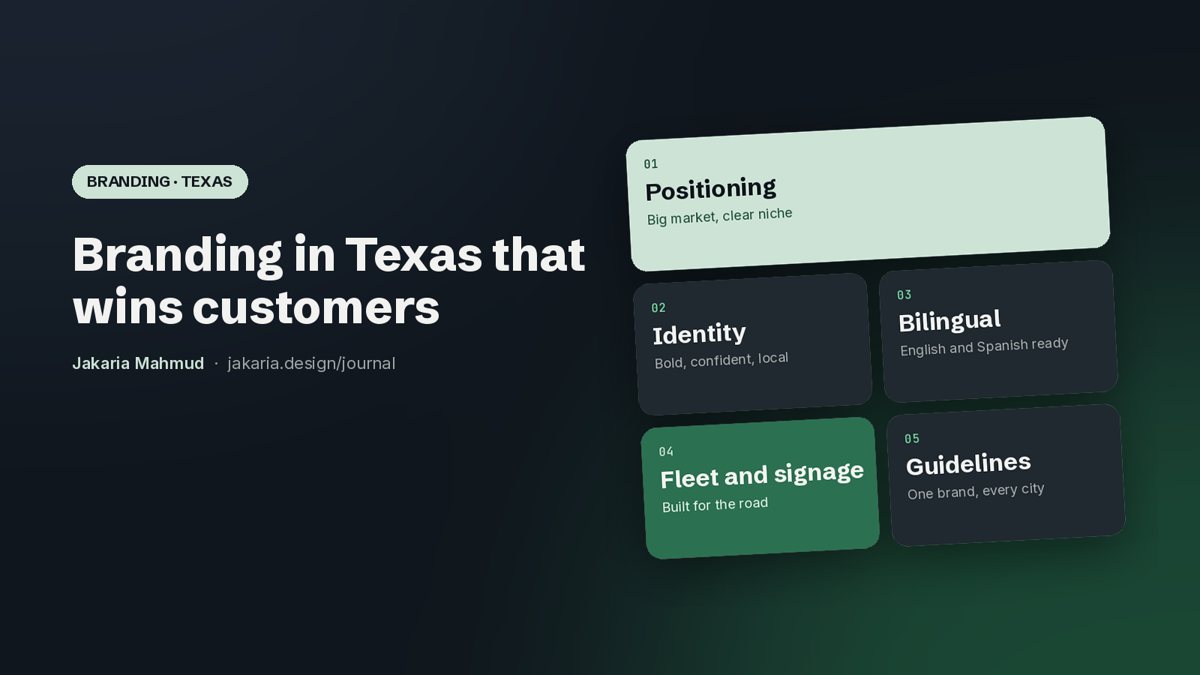
What a Texas brand identity should include
- Positioning and messaging. Who you serve, where, and why you win, written down before design starts.
- Logo system. Primary logo, compact mark and icon that work on a truck, a hard hat, a yard sign and an app.
- Colour and typography. A confident palette with high contrast for outdoor use and type that supports English and Spanish.
- Photography direction. Real people, real projects and real places instead of stock.
- Sales materials. Proposal, capability statement, pitch deck or brochure in the new identity.
- Vehicles, signage and uniforms. Placement rules for every vehicle and location.
- Digital presence. Website, Google Business Profile, social templates and email signatures.
- Brand guidelines. One guide for every office, crew, agency and printer.
Practical things to plan early
- Trademarks. Search before you commit to a name. You can register a trademark with the State of Texas through the Secretary of State, and federally with the USPTO if you sell across state lines. A trademark attorney can advise which you need.
- Assumed names. If you trade under a name that differs from your legal entity, Texas generally requires an assumed name certificate, so keep your brand name and filings aligned.
- Google Business Profile. For local businesses, your profile is often the first impression. Keep the name, logo, photos and categories consistent with the brand.
- Time zones. Most of Texas runs on Central Time. Working with a designer in Dhaka means your morning is my evening, and written daily progress keeps the project moving overnight.
This is not legal advice. Confirm requirements with the Texas Secretary of State or an attorney.
How much does brand identity design cost in Texas?
Prices vary widely, from a freelancer selling a logo to a large agency running a months long rebrand. What drives the cost is how much strategy is included, how many applications are designed, whether the brand needs bilingual materials and whether guidelines and files are handed over in full.
My pricing is fixed and in US dollars. The Launch plan, a logo and brand starter kit with one landing page, is $799 one time. A full brand identity with guidelines, website and ongoing design is part of the Partner plan at $1,999 per month. Every project starts with a written brief. See the full plans.
A branding process that works for Texas companies
- Audit. A 30 minute call in your morning and a teardown of your brand, website, Google profile and sales material.
- Positioning brief. Audience, service area, promise and messaging agreed in writing.
- Identity design. Logo, colour, typography and rules, shown on your real trucks, signs, site and deck.
- Rollout. Guidelines, templates and print ready files, with a walkthrough for your team.
A starter identity takes about a week. A full identity with guidelines and website usually runs three to five weeks.
How to choose a brand identity designer for a Texas business
- Look for full identity systems in the portfolio, not only logos.
- Ask how they handle vehicles, signage and job site applications if you have them.
- Check that positioning and messaging come before design.
- Confirm you own all files and rights at the end.
- Choose someone who understands sales, because the brand has to win work, not just win awards.
6 Texas branding mistakes to avoid
- Leaning on clichés. A star, a longhorn or a state outline is not a brand strategy.
- Trying to serve everyone. Texas is too big for a vague promise. Pick a niche and own it.
- Thin, detailed logos. They disappear on trucks, yard signs and hard hats.
- Ignoring Google. A great brand with a neglected Google profile loses local searches.
- English only by default. If part of your market speaks Spanish, plan for it from day one.
- No guidelines. Every new location or crew slowly invents its own version of the brand.
Texas brand identity checklist
- Clear niche, service area and promise
- Bold logo system that works outdoors and on screens
- High contrast palette and typography with Spanish support
- Vehicle, signage and uniform rules
- Proposal, deck or capability statement templates
- Website and Google Business Profile aligned with the brand
- Trademark search and assumed name filings in order
- Brand guidelines and full file handover
Where I fit: Jakaria Mahmud
I build brands with a business mindset and grow businesses with a brand mindset. The US is my biggest market, and as Head of Sales and Business Development at Wolf Pixel, a company based in Louisiana, I work on US proposals, discovery calls and client relationships every day. That is why I design brands to win deals and bids, not just to look good.
- What I deliver: positioning, brand identity design, guidelines, vehicle and signage concepts, proposals and decks, and websites in Webflow, Framer or WordPress.
- Proof: 80+ clients in 12 countries, $1.4M+ in revenue impacted and a 5.0 rating on Google.
If you run a company in Texas, see my brand identity designer for the USA page or book a free 30 minute brand audit. For how brand needs differ across US industries, read what the best brand design in the USA looks like.
The takeaway
Great Texas branding is clear, confident and built for real life: trucks, job sites, Google searches and sales meetings. Pick a niche, design a bold system that works in every city and in both languages, and put it into guidelines your whole team can follow. Do that, and your brand starts winning work before you pick up the phone.
Frequently asked questions
It depends on scope, from a simple logo to a full identity with strategy and guidelines. My pricing is fixed in US dollars: the Launch plan, a logo and brand starter kit with one landing page, is $799 one time, and a full identity with guidelines and website is part of the Partner plan at $1,999 per month.
A Texas trademark through the Secretary of State protects you within the state, while a federal registration with the USPTO covers the whole country and is usually the better choice if you sell across state lines. A trademark attorney can advise on your situation.
If a meaningful share of your customers speak Spanish, yes. Plan a Spanish tagline, choose typefaces with full accent support and have Spanish copy written or reviewed by a native speaker.
It should be bold, simple and legible from a distance, work in one colour on trucks, yard signs and hard hats, and stay clear when scaled down for a Google profile or app icon.
Yes. The work runs on a shared Figma file with written updates and calls in your morning Central Time. You get one senior designer accountable for the result, with fixed pricing.
A starter identity with one landing page takes about a week. A full identity with guidelines and website usually runs three to five weeks, depending on feedback.
Any business competing on trust: SaaS and tech startups in Austin, energy and industrial firms in Houston, professional services in Dallas and Fort Worth, and construction, logistics, healthcare and home services across the state.