Branding · 9 min read
Sustainable energy branding: how solar, battery and clean energy companies build trust and win customers
Clean energy buyers are sceptical, and every brand in the category looks the same. Here is how solar, storage and energy tech companies build a brand people trust, without greenwashing.

Jakaria MahmudBrand identity and UI/UX designer ·
Almost every sustainable energy brand looks the same: a green leaf, a sun icon, a blue gradient and a promise to "power a better tomorrow". Meanwhile the buyers have become more sceptical. Homeowners compare quotes, businesses ask for payback numbers, investors ask for proof, and regulators are cracking down on vague green claims. In that market, a clear and honest brand is a real competitive advantage.
I am Jakaria Mahmud, a brand identity and UI/UX designer who builds brands with a business mindset. This guide explains what great sustainable energy branding looks like in 2026, how it differs across solar, storage and energy tech, how to avoid greenwashing, and what a complete clean energy brand identity should include.
Key takeaways. Win on clarity and proof, not on leaves and slogans. Position around a specific customer and outcome, back every environmental claim with evidence, design your data so savings and impact are easy to understand, and make the website do the selling with quotes, calculators and real installations.
Why branding matters in sustainable energy
- High-consideration purchases. Solar systems, batteries and energy contracts are big decisions with long paybacks. People buy from companies that feel stable enough to still be around in 20 years.
- A crowded, look-alike category. When every competitor uses the same symbols, a distinctive identity is the fastest way to be remembered.
- Scepticism and green claims. Buyers and regulators increasingly challenge vague environmental claims. A brand built on specific, provable statements earns trust that slogans cannot.
- Multiple audiences. Homeowners, facility managers, investors, installers and future employees all judge the same brand. It has to work for each of them.
Know who you are branding for
The biggest positioning decision in clean energy is choosing the customer. Each audience needs a different promise:
- Homeowners want lower bills, reliability and a trustworthy installer. They respond to simple savings numbers, reviews and a clear process.
- Businesses and facility managers want cost certainty, energy resilience and reporting they can share. They respond to case studies, ROI and credibility.
- Utilities, developers and investors want bankability: track record, technical depth and governance.
- Installers and partners want a brand that makes them look good in front of their own customers.
Trying to speak to all of them equally usually produces a brand that speaks to none. Pick the primary audience, then design supporting messages for the others.
The elements of a strong clean energy brand identity
1. Positioning and messaging
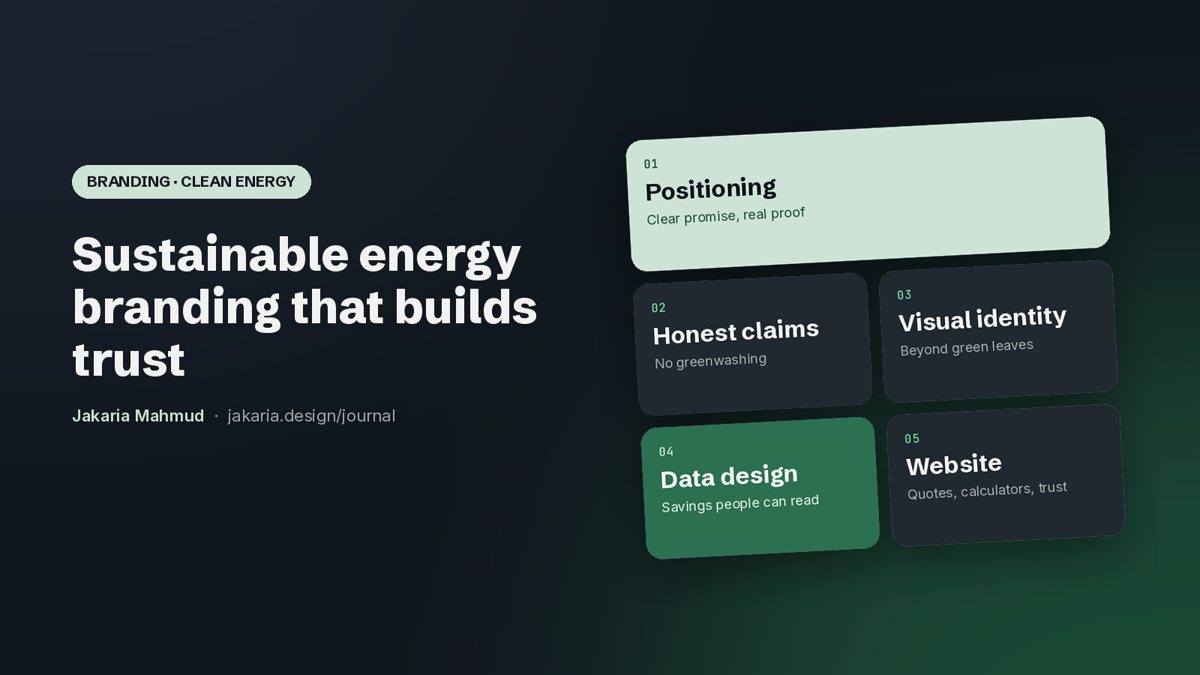
Write down who you serve, the outcome you deliver and why you are different, in plain language. "Solar for homes" is a category. "Solar and battery systems for homeowners who want predictable bills, installed and monitored by one local team" is a position. Back it with three or four message pillars, each tied to proof such as installations completed, warranties, response times or verified savings.
2. Name and descriptor
Many names in this space include "solar", "green", "eco" or "power", which makes them hard to own. If you have a generic name, pair it with a strong, specific descriptor and a distinctive visual system. If you are naming from scratch, check trademark, domain and social availability early.
3. Visual identity beyond green leaves
You do not need a leaf, a sun or a lightning bolt to signal clean energy. Stronger identities use a simple, ownable mark, confident typography and a colour system that stands apart from the category's default greens and blues. The goal is to look like a serious energy company first and a sustainable one second, because the sustainability is proven by what you do, not by the icon.
4. Colour with a purpose
Choose a primary colour that is distinctive in your market, then build a functional palette for data: positive and negative values, energy generated versus consumed, charge states and alerts. Check contrast so charts and dashboards stay readable for everyone.
5. Data design
Clean energy brands live on numbers: kilowatt-hours, savings, payback years, tonnes of carbon avoided. A brand system should include rules for charts, dashboards and simple one-number graphics, so impact is easy to understand in a proposal, a report or an app. This is where brand identity and UI/UX design meet, especially for monitoring apps and customer portals.
6. Photography and imagery
Use real installations, real teams and real customers. Stock photos of smiling families under generic panels are everywhere and prove nothing. A small library of your own project photography, shot consistently, is one of the most valuable brand assets you can build.
7. Tone of voice
Confident, specific and calm. Replace "revolutionising the future of energy" with what you actually do and what it saves. Explain technical ideas simply without talking down to people.
8. Applications
Vans and uniforms for installers, site signage, proposals and quotes, investor decks, monitoring apps and social templates. A clean energy brand is judged at the kitchen table and in the boardroom, so both need to feel like the same company.
Honest claims: how to avoid greenwashing
Environmental claims are now closely watched. In the US the FTC's Green Guides set expectations for environmental marketing, and the EU has introduced rules against generic claims such as "eco-friendly" or "green" without proof. Good branding makes honesty easy:
- Be specific. "Our systems generated 4.2 GWh for customers last year" beats "powering a greener planet".
- Show your working. Link claims to data, certifications or methodology.
- Avoid absolute words like "zero impact" or "100% green" unless you can prove them.
- Separate aspiration from fact. Targets are fine, as long as they are clearly presented as targets.
This is not legal advice, so check claims with a qualified advisor in your market. From a brand point of view, specific proof is also simply more persuasive.
Branding by clean energy sector
| Sector | What buyers need to believe | Brand priorities |
|---|---|---|
| Residential solar | You are trustworthy, local and will be around for the warranty | Reviews, simple savings story, clear process, vans and yard signs, quote flow |
| Commercial and industrial solar | The numbers work and the project will be managed professionally | ROI case studies, proposals, capability statements, reporting design |
| Battery storage and EV charging | The technology is reliable and easy to live with | Product and app UI, charging station signage, clear energy data |
| Energy and climate tech (SaaS) | The platform delivers measurable savings or compliance | Product-ready identity, dashboard design, investor deck, website that explains the product fast |
| Utilities and community energy | You are fair, transparent and accountable | Plain-language communication, accessibility, bills and portals that make sense |
The website: where clean energy brands sell
For most sustainable energy companies, the website is the main salesperson. It should make three things obvious in seconds: what you do, who it is for and why you are credible. Then it should help people act.
- A clear headline with the outcome, not a slogan.
- A savings or quote calculator, or a short qualifying form.
- Proof: installations completed, reviews, certifications, case studies with real numbers.
- A simple process section: survey, design, install, monitor.
- Fast pages and mobile-first design, because many visitors arrive from ads on their phones.
More on this in why most business websites do not convert, and the three fixes that change it.
How to build a sustainable energy brand, step by step
- Audit. Review your current brand, website, proposals and competitors. Talk to recent customers about why they chose you.
- Positioning. Agree the primary audience, promise, proof and message pillars in writing.
- Identity concepts on real applications. Test each direction on a van, a proposal, a dashboard and the homepage.
- System and guidelines. Build the full system, including data and chart rules, and document it.
- Rollout. Website and sales documents first, then vehicles, signage and product UI.
What clean energy branding costs
A logo and brand starter kit for a new installer or startup can take about a week. A full identity with guidelines, data design, proposal templates and a new website usually takes several weeks. My pricing is fixed: the Launch plan, a logo and brand starter kit with one landing page, is $799, and full brand identity with guidelines, website and product design sits in the Partner plan at $1,999 per month. Whoever you hire, ask for a fixed scope and a written brief.
6 sustainable energy branding mistakes
- Leaf, sun and gradient by default. It makes you look like everyone else.
- Vague green claims. They weaken trust and can create legal risk.
- Talking to everyone. Homeowners and utilities need different messages.
- Numbers nobody can read. Savings and impact need clear data design.
- Stock photography. Real installations are more convincing.
- A slow, confusing website. It is often the first and last impression.
Clean energy brand checklist
- Primary audience and positioning statement written down
- Message pillars, each backed by specific proof
- Distinctive logo and colour system that avoids category clichés
- Data and chart guidelines for savings and impact
- Real project photography library
- Claims reviewed for accuracy and evidence
- Proposal, quote and investor deck templates
- Vehicle, uniform and signage designs
- Website with calculator or quote flow, proof and process
- Guidelines your team and partners can actually use
Where I fit: Jakaria Mahmud
I build brands with a business mindset and grow businesses with a brand mindset. Alongside design, I lead sales and business development as Head of Sales and Business Development at Wolf Pixel, so I design energy brands around the moments that decide deals: the quote, the proposal, the site survey and the first call.
- What I deliver: positioning, brand identity design, guidelines, data and dashboard design, proposal templates and websites in Webflow, Framer or WordPress.
- Proof: 80+ clients in 12 countries, $1.4M+ in revenue impacted and a 5.0 rating on Google.
If you run a solar, storage or energy tech company, see the brand identity design service or book a free 30 minute brand audit. For other industries, read how SaaS, AI, startup, logistics and construction companies choose a branding partner.
Working on the energy transition in a specific market? See brand identity design for Saudi Arabia, the Netherlands, Switzerland and the UK.
The takeaway
The best sustainable energy brands do not shout about saving the planet. They choose a clear customer, make specific promises, prove them with real data and real projects, and design every touchpoint so trust is easy. In a category full of leaves and slogans, clarity is the most distinctive thing you can offer.
Frequently asked questions
A good sustainable energy brand has a clear target customer, a specific promise backed by proof, a distinctive visual identity that avoids category clichés, honest environmental claims, clear data design for savings and impact, and a website that makes quoting or contacting the company easy.
No. Green, leaves and suns are so common in the category that they make brands look alike. A distinctive mark and colour system, supported by real proof of impact, usually does more for recognition and trust.
Make specific, verifiable claims, link them to data or certifications, avoid absolute terms like zero impact unless proven, and clearly separate targets from achievements. Check claims against the rules in your market, such as the FTC Green Guides in the US.
It depends on scope. A logo and brand starter kit can be a small fixed fee, while a full identity with guidelines, data design, proposal templates and a website costs more. Jakaria Mahmud's Launch plan starts at a fixed $799.
Many energy products include monitoring apps, customer portals or dashboards. If the brand does not extend into those screens, the experience feels disconnected. Designing brand and product together keeps data clear and the company consistent.