Branding · 8 min read
Logistics company branding: how freight, 3PL and delivery brands win shippers, drivers and trust
In logistics, your brand is judged on reliability: on the road, in the tracking portal and in every RFP. Here is how freight, 3PL and delivery companies build a brand that wins shippers and drivers.

Jakaria MahmudBrand identity and UI/UX designer ·
Logistics is a trust business. Shippers hand you their inventory, their deadlines and their customer relationships. Drivers decide whether to join and stay. Partners decide whether to send you loads. Long before anyone reads your rate sheet, your brand has already told them whether you look organised, reliable and easy to work with.
I am Jakaria Mahmud, a brand identity and UI/UX designer who works with logistics and B2B companies. This guide covers what strong logistics branding looks like, the elements a freight, 3PL or delivery company needs, how branding differs by sector and how to roll it out across trucks, portals and sales materials.
Key takeaways. Position around a clear niche and promise, design a fleet livery that reads at highway speed, extend the brand into tracking and customer portals, make every RFP and rate sheet look professional, and treat driver recruitment as part of the brand, not an afterthought.
Why branding matters for logistics companies
- Commoditised markets. When many carriers and brokers offer similar lanes and rates, reliability and professionalism are what separate you. Brand is how they are perceived before they are proven.
- Longer, bigger contracts. Enterprise shippers run formal RFPs and vendor reviews. A consistent, credible brand makes you easier to shortlist and easier to defend internally.
- Driver shortages. Recruitment and retention are ongoing challenges. A brand drivers are proud to carry helps with both.
- Digital expectations. Shippers now expect real-time visibility. Your tracking experience is part of your brand.
- Growth and acquisitions. Logistics companies often grow through new services and acquired fleets. A clear brand architecture keeps it all recognisable.
Who a logistics brand has to convince
- Shippers and procurement teams want reliability, coverage, visibility and fair pricing.
- Consignees and end customers see your trucks, your drivers and your delivery notifications.
- Drivers and owner-operators want steady work, fair pay, good equipment and respect.
- Partners and carriers want easy onboarding and prompt payment.
- Investors and lenders want operational maturity and growth potential.
The elements of a strong logistics brand identity
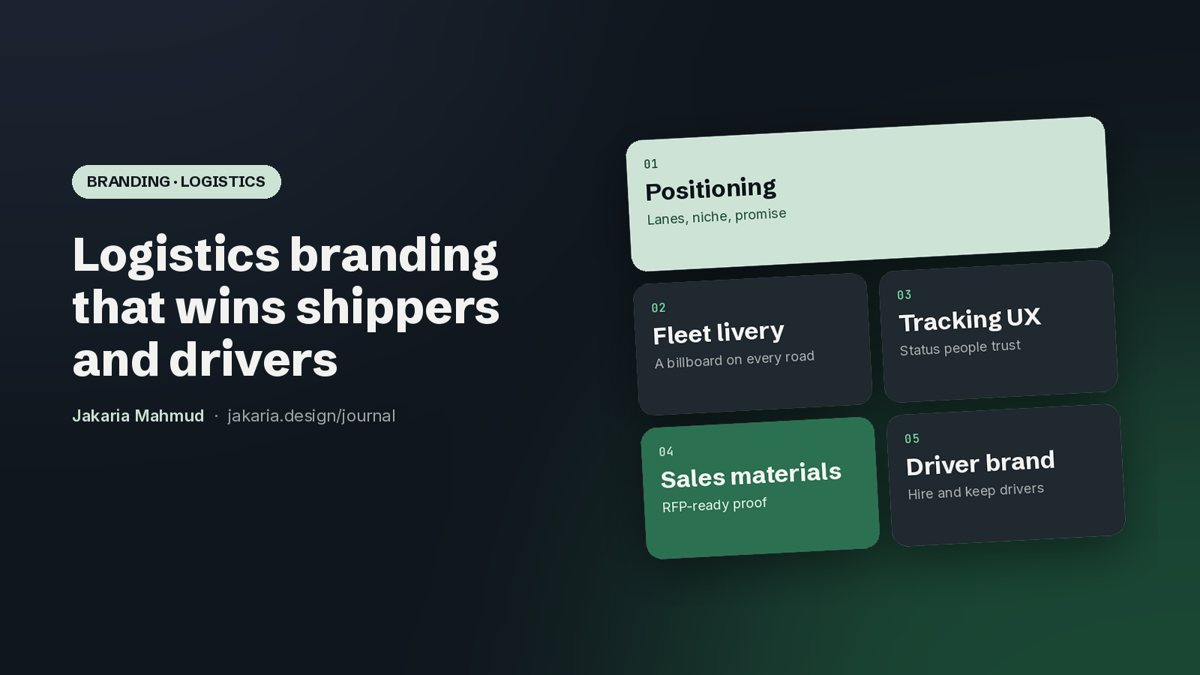
1. Positioning and niche
"Nationwide freight solutions" describes half the industry. A strong position names the niche and the promise: temperature-controlled freight for food producers, cross-border lanes, same-day delivery for a specific region, or white-glove handling for high-value goods. Back it with proof such as on-time performance, claims ratio, coverage and years of experience.
2. Name and brand architecture
Many logistics companies run several services: brokerage, trucking, warehousing, last mile. Decide early whether they share one master brand or have sub-brands, and make the relationship clear. Confusing names cost trust at every handoff.
3. A logo built for the road
Your logo will live on trailer sides, cab doors, uniforms, labels, app icons and mobile screens. It needs to be bold, simple and legible at distance and at speed, work in one colour, and scale down to a favicon without losing its shape.
4. Colour and a status system
Pick a primary colour that stands out on the road and on screen. Then define functional colours for status: in transit, delayed, delivered, exception. Using them consistently across emails, portals and driver apps makes the whole operation feel more reliable.
5. Fleet livery
Trucks and trailers are your biggest marketing channel. A good livery system has simple placement rules for different vehicle types, keeps the logo, service and contact visible, and stays affordable to apply and maintain. Clean, consistent fleets signal a well-run company.
6. Tracking, portals and apps
For many shippers the tracking page or customer portal is where they meet your brand most often. Clear shipment status, useful notifications, simple documents and fast support are part of the brand promise. This is where brand identity and UI/UX design need to work together, and the same onboarding principles apply as in SaaS onboarding UX.
7. Sales and RFP materials
Capability statements, RFP responses, rate sheets, lane maps and case studies should all use the same templates. Consistent, well-designed sales documents save time on every bid and make a smaller company look as organised as a large one.
8. Website
The website should make services, lanes and coverage clear in seconds, show proof such as safety records and on-time metrics, offer a fast quote request, and include tracking and a careers section. Many visitors are procurement teams on desktop and drivers on mobile, so it has to work for both.
9. Driver and employer brand
A dedicated careers page, clear information on pay, routes and home time, real driver stories, and branded uniforms and equipment help you hire and keep drivers. A strong employer brand is a direct operational advantage.
10. Warehouses, signage and uniforms
Warehouse signage, dock labelling, uniforms and safety materials complete the system. They are what customers see during site visits and audits.
Logistics branding by sector
| Sector | What buyers need to believe | Brand priorities |
|---|---|---|
| Trucking and carriers | You are safe, on time and communicate well | Fleet livery, driver brand, safety proof, quote and tracking |
| Freight brokerage | You find capacity fast and handle problems before they escalate | Positioning by niche or lane, responsive sales materials, carrier onboarding experience |
| 3PL and warehousing | Your operation is accurate, scalable and integrated with their systems | Case studies, facility signage, client portal and reporting design |
| Last-mile delivery | You protect their customer experience at the door | Driver uniforms, vans, delivery notifications, customer-facing tracking |
| Freight forwarding and customs | You understand global trade and paperwork | Clear service architecture, multilingual materials, document templates |
| Logistics technology | The platform saves time and cost and is easy to adopt | Product-ready identity, dashboard UX, fast-explaining website, investor deck |
How to build a logistics brand, step by step
- Audit. Collect every brand touchpoint: vehicles, website, portal, emails, RFPs, uniforms, signage. Interview a few shippers and drivers.
- Positioning. Agree niche, promise, proof and message pillars in writing.
- Identity concepts on real applications. Test each direction on a trailer, a tracking screen, an RFP cover and the homepage.
- System and guidelines. Build the full system, including status colours and livery rules, and document it for suppliers.
- Phased rollout. Digital and documents first, then new vehicles and uniforms, then the rest of the fleet as it is replaced or rewrapped.
The same phased approach works well in other asset-heavy industries, as described in the best brand identity for construction companies.
What logistics branding costs
A logo and brand starter kit for a small carrier or new brokerage can take about a week. A full identity with guidelines, livery design, sales templates and a new website usually takes several weeks, and portal or app design is scoped separately. Wraps and signage are produced by your suppliers. My pricing is fixed: the Launch plan, a logo and brand starter kit with one landing page, is $799, and full brand identity with guidelines, website and product design sits in the Partner plan at $1,999 per month.
7 logistics branding mistakes
- Generic positioning. "Reliable freight solutions" does not win RFPs.
- Logos that fail at distance. Thin lines and small text disappear on a trailer.
- Inconsistent fleets. Mixed old and new liveries without a plan look disorganised.
- Ignoring the tracking experience. A confusing portal undoes a great brand.
- Improvised sales documents. Every RFP looks different and takes longer.
- Forgetting drivers. The employer brand matters as much as the customer brand.
- No brand architecture. New services and acquisitions become a patchwork.
Logistics brand checklist
- Niche, promise and proof written down
- Clear brand architecture for services and sub-brands
- Bold logo that works on trailers, uniforms and app icons
- Primary colours plus a status colour system
- Fleet livery rules for every vehicle type
- Tracking, portal and notification design in the brand
- RFP, capability statement, rate sheet and case study templates
- Website with services, coverage, proof, quote, tracking and careers
- Driver recruitment page and employer brand
- Warehouse signage, uniforms and practical guidelines
Where I fit: Jakaria Mahmud
I build brands with a business mindset and grow businesses with a brand mindset. Logistics is one of the industries I work with, and as Head of Sales and Business Development at Wolf Pixel I spend my days on the same things logistics sales teams do: RFPs, proposals, discovery calls and follow-up. That is why I design brands to hold up in a procurement review, not just on a truck.
- What I deliver: positioning, brand identity design, guidelines, livery concepts, RFP and sales templates, tracking and dashboard UI, and websites in Webflow, Framer or WordPress.
- Proof: 80+ clients in 12 countries, $1.4M+ in revenue impacted and a 5.0 rating on Google.
If you run a freight, 3PL or delivery company, see the brand identity design service or book a free 30 minute brand audit. For how brand needs differ across industries, read what great brand design looks like for logistics and other US companies.
Moving goods through a major hub? See brand identity design for Dubai and the UAE, the Netherlands and the USA.
The takeaway
Great logistics branding is reliability made visible. A clear niche, a fleet that looks well run, a tracking experience that reduces anxiety, sales documents that look as organised as your operation and a brand drivers are proud of. Get those right and your brand starts winning loads before your sales team picks up the phone.
Frequently asked questions
Logistics markets are competitive and often commoditised, so reliability and professionalism decide who wins. A consistent brand across fleet, website, tracking and sales documents makes a company easier to shortlist in RFPs, easier to trust and easier to work for.
It should be bold, simple and legible at distance and at speed, work in one colour on trailers and uniforms, and scale down to an app icon. Avoid thin lines, gradients and small text that disappear on vehicles.
Create a livery system with simple placement rules for each vehicle type, keeping the logo, service and contact details clear. Roll it out as vehicles are replaced or rewrapped so the fleet becomes consistent without a large one-time cost.
Yes. Shippers interact with tracking pages, notifications and portals more often than with most other touchpoints. Clear status design, consistent colours and helpful updates are part of the brand promise of reliability.
It depends on scope. A logo and brand starter kit can be a small fixed fee, while a full identity with guidelines, livery design, sales templates and a website costs more, and vehicle wraps are produced separately. Jakaria Mahmud's Launch plan starts at a fixed $799.