Branding · 8 min read
Fintech branding: how to build a brand people trust with their money
In fintech the brand is a trust signal before it is anything else. Here is how to position a fintech brand, design a logo and colour system that feel secure without looking like a bank, stay compliant in the USA, UK and Gulf, and carry it into the product.

Jakaria MahmudBrand identity and UI/UX designer ·
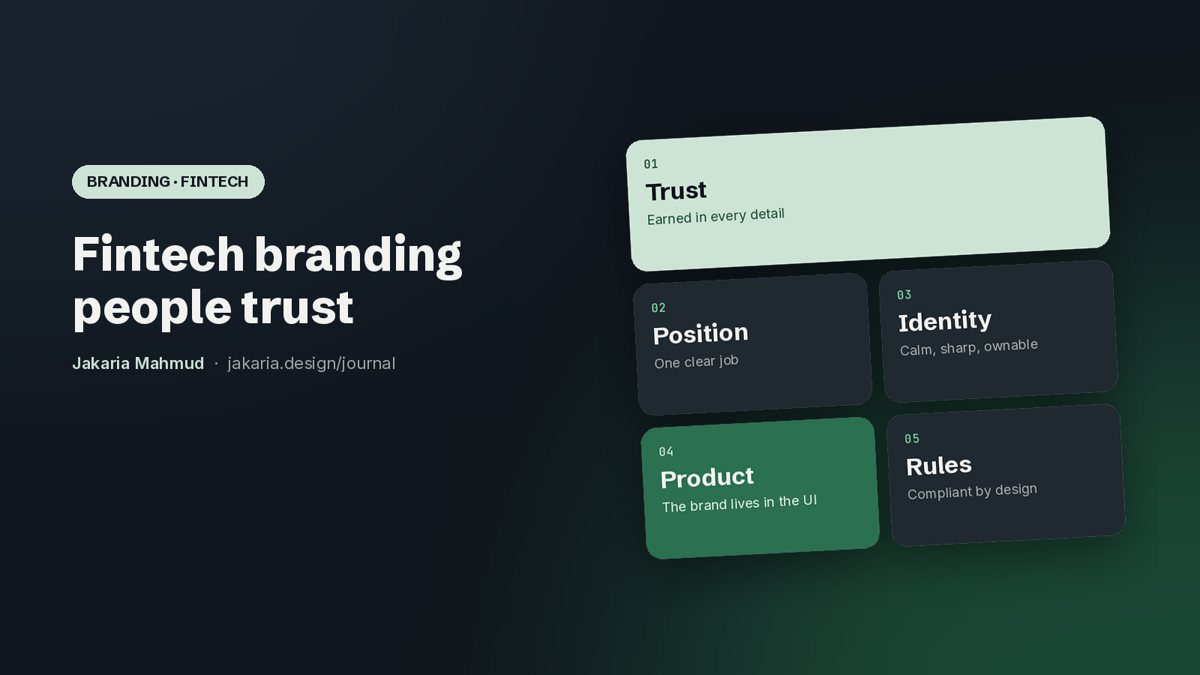
People hand a fintech brand their salary, their savings or their company payroll, often before they have spoken to a single human there. That makes the brand do a job most brands never face: it has to look trustworthy enough to hold money, and modern enough to be worth switching from the bank they already have.
I am Jakaria Mahmud, a brand strategist and brand identity designer working with startups and SaaS companies in the USA, UK, the Gulf and Europe, including fintech brands such as MYPA and OneClick. This guide covers how to position a fintech brand, what the identity needs, how compliance shapes it, how the brand carries into the product and what it costs.
Short answer. Fintech branding is building a brand that earns trust with money. Start with one clear position: who you serve and the one financial job you do better than banks and competitors. Then design an identity that feels secure without looking like a bank: a simple, ownable logo, a restrained colour system with one distinctive accent, readable typography for numbers, and plain language. Keep every claim compliant in your markets, and treat the app and onboarding as the most important brand touchpoints.
Why fintech branding is different
- Trust comes first. A fashion brand can be loved for being bold. A fintech brand is judged on whether it feels safe, so every detail, from spacing to error messages, either builds or drains confidence.
- The market looks the same. Many fintechs use the same blue, the same rounded sans serif and the same card mockup. Looking generic makes you forgettable and makes switching feel pointless.
- Claims are regulated. Financial promotions are checked by regulators in most markets, so the messaging has to be bold and accurate at once.
- The product is the brand. Most customers meet you through an app or dashboard. If onboarding is confusing, no logo can fix the impression.
Step 1: position the brand before you design it
Most weak fintech brands are positioning problems in disguise. Answer these before any design work:
- Who exactly is it for? Freelancers paid in dollars, SMEs paying suppliers abroad, Gen Z saving for the first time and finance teams closing the month are very different audiences.
- What do they use today? Usually a bank, a spreadsheet or a competitor. Your brand has to explain why switching is worth the effort.
- What is the one job you do better? Faster payouts, lower fees, clearer spending or easier compliance. Pick one and lead with it.
- What proof can you show? Licences, partner banks, security standards, customer numbers or results you can stand behind.
Write the answers as one positioning statement and test it: if a competitor could say the same sentence, it is not finished. My guide on what a brand strategist does walks through this in more detail, and the brand strategy service turns it into a brief.
Step 2: the fintech brand identity
| Element | What works in fintech | What to avoid |
|---|---|---|
| Logo | A simple wordmark or symbol that works as a 24 pixel app icon and on a payment card | Coins, arrows and dollar signs that every competitor already uses |
| Colour | A calm base with one ownable accent, plus clear colours for success, warning and error | Default corporate blue with nothing that is yours |
| Typography | A typeface with clear, tabular numbers that stay readable in tables and balances | Thin or decorative fonts that make figures hard to read |
| Imagery | Real product screens, real people and simple illustrations of real outcomes | Generic stock photos of handshakes and floating coins |
| Voice | Plain, calm and specific: fees, timings and limits said clearly | Hype words and promises you cannot prove |
| Motion | Short, confident animation for logo reveals and payment confirmations | Slow or playful motion around money moments |
The logo matters more than usual because it sits on app stores, cards and banking screens next to large institutions. See how I approach it on the logo design page.
Step 3: design trust signals into the brand
- Licences and partners in plain view. Name the regulator, licence and partner bank where customers decide, not only in the footer.
- Transparent pricing. Fees shown in the same style everywhere, never hidden in small grey type.
- Consistent details. The same logo, colours and tone in the app, emails, statements and support. Inconsistency looks like a scam to cautious users.
- Human support. Real names and clear ways to reach people, written in the brand voice.
- Accessible design. Strong contrast and readable numbers help everyone and signal care.
Step 4: stay compliant in every market
Brand and marketing claims in financial services are regulated. In the UK, financial promotions must be fair, clear and not misleading under FCA rules. In the USA, rules depend on the product and can involve the SEC, FINRA, the CFPB and state regulators. In the UAE and wider Gulf, licensing and marketing rules come from bodies such as the Central Bank of the UAE, the DFSA and the FSRA. I am not a lawyer, so the practical approach is simple: design the messaging framework with your compliance lead from day one, so the brand voice is approved once rather than argued over every campaign.
For Gulf launches, design Arabic and English versions of the identity together, with Arabic copy reviewed by a native speaker. More on that in brand identity design in Dubai.
Step 5: carry the brand into the product
For most fintech customers the app is the brand. Onboarding, identity checks, the first deposit and the first payment are where trust is won or lost. On Fintrack, a fintech SaaS dashboard, an onboarding redesign took task completion from 50% to 95%. That kind of change does more for the brand than any campaign. Read SaaS onboarding UX: seven fixes, or see the UI/UX design service.
Fintech brand identity examples from my work
Two fintech identities I have published on Behance show these principles in practice:
- MYPA: a modern fintech brand identity built to make financial experiences feel simpler and more trustworthy, balancing the credibility of a financial brand with a digital first product. See the MYPA fintech brand identity on Behance.
- OneClick: a fintech brand identity with a logo designed to work in the app, on cards and in motion. See the OneClick brand identity on Behance and the OneClick logo animation.
What fintech branding costs
Costs follow the same ranges as any brand identity, plus extra time for compliance review, product UI and multilingual versions. Senior independent designers usually cost a few thousand to the low tens of thousands of dollars; specialist agencies often charge far more. See brand identity design cost in the USA and branding cost in the UK for detail.
My pricing is fixed in US dollars: the Launch plan at $799 one time covers a positioning brief, logo, brand starter kit and landing page, and the Partner plan at $1,999 per month covers full strategy, identity, brand guidelines, website and product design.
6 fintech branding mistakes
- Looking like every other fintech. Blue, rounded and forgettable.
- Looking like a bank. So safe that there is no reason to switch.
- Promising what you cannot prove. A compliance risk and a trust risk.
- Hiding fees and licences. Cautious users read hidden details as a warning.
- Designing the logo but not the app. The product is where people meet the brand.
- Ignoring small sizes. The logo has to work as an app icon and on a card first.
Fintech brand checklist
- One positioning statement no competitor could use
- Logo tested as an app icon, on a card and in motion
- Colour system with an ownable accent and clear status colours
- Typography with readable, tabular numbers
- Messaging framework reviewed by compliance
- Licences, partners and fees shown where people decide
- Onboarding and first transaction designed in the brand
- Brand guidelines covering product UI, marketing and support
Where I fit: Jakaria Mahmud
I build brands with a business mindset and grow businesses with a brand mindset. For fintech that means positioning first, an identity that feels secure and distinctive, and a product experience that carries the same trust into every screen, from one person who covers strategy, brand identity design and UI/UX.
- Markets: the USA, UK, UAE, Saudi Arabia, Qatar, Switzerland, the Netherlands and Bangladesh. See the pages for the USA and UK.
- Proof: 80+ clients in 12 countries, $1.4M+ in revenue impacted and a 5.0 rating on Google.
- How to start: a free 30 minute audit of your brand, website and onboarding.
The takeaway
Fintech branding is trust design. Pick one clear position, build an identity that feels safe without looking like a bank, keep every claim compliant, and make the product the strongest part of the brand. Do that and the brand starts doing part of the selling for you.
Further reading: FCA guidance on financial promotions.
Frequently asked questions
Fintech branding is building the positioning, identity and experience of a financial technology company so people trust it with their money. It covers strategy, logo, colour, typography, voice, trust signals, compliance in messaging and the product experience.
One clear position, a simple ownable logo that works as an app icon and on a card, a calm colour system with one distinctive accent, typography with readable numbers, plain language and visible trust signals such as licences, partners and transparent fees.
Blue is common because it signals stability, which is exactly why it rarely stands out. A better approach is a calm, trustworthy base with one ownable accent colour, plus clear colours for success, warning and error states in the product.
Senior independent designers usually charge a few thousand to the low tens of thousands of dollars, and specialist agencies often charge much more. Jakaria Mahmud offers a $799 Launch plan and full strategy, identity and product design in the $1,999 per month Partner plan.
Yes. Financial promotions are regulated in most markets, such as by the FCA in the UK and by regulators including the SEC, FINRA and the CFPB in the USA depending on the product. Messaging should be reviewed by your compliance team or legal advisers.
No. It should feel as safe as a bank but give people a reason to switch. Borrow the trust signals, not the look: clear licences, transparent fees and consistent details, with a modern, distinctive identity.
Yes. Jakaria Mahmud's fintech identities include MYPA and OneClick, published on Behance, and the Fintrack fintech dashboard, where an onboarding redesign took task completion from 50% to 95%.