Branding · 9 min read
How to build a brand from scratch: a 10 step guide for startups and small businesses
A brand is not a logo. It is the reason people choose you, remember you and recommend you. Here is a practical 10 step process to build a brand from scratch, with what each step costs, how long it takes and how to make sure Google and AI assistants understand your brand too.

Jakaria MahmudBrand strategist and brand identity designer ·
Most new businesses start with a name and a logo and call it a brand. A few months later they notice the problem: customers compare them on price, the website says something different from the sales deck, and nobody can explain in one sentence why they are different. Building a brand properly fixes that, and it does not need a big agency budget.
I am Jakaria Mahmud, a brand strategist and brand identity designer. I have helped 80+ clients in 12 countries, from early stage startups to growing companies in the USA, UK, the Gulf and Europe. This guide is the same 10 step process I use with clients, written so you can follow it yourself or know what to expect from a designer.
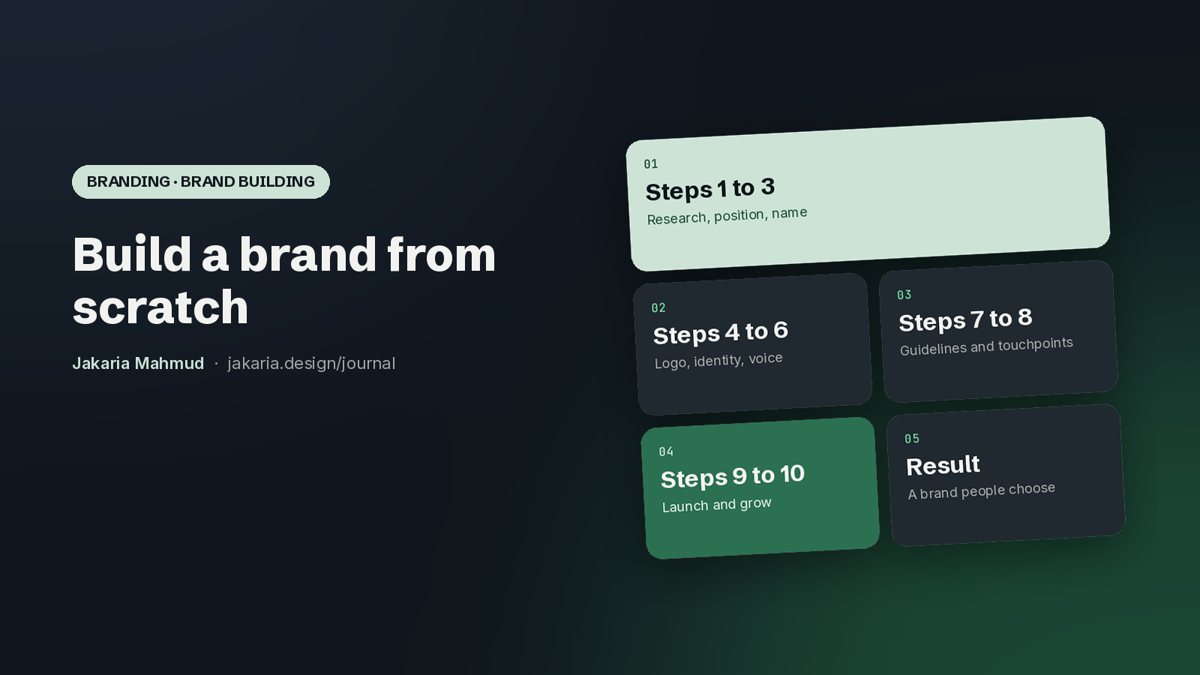
Short answer. To build a brand from scratch: (1) research your customers and competitors, (2) define your positioning, (3) choose a name you can own, (4) design a logo, (5) build a visual identity, (6) set a brand voice and message, (7) write brand guidelines, (8) apply the brand to every touchpoint, (9) launch it consistently everywhere, including Google and AI search, and (10) measure and keep it consistent. Strategy comes first, design second. A small business can do the core in 4 to 8 weeks.
What building a brand actually means
A brand is what people think and feel when they hear your name. You cannot control that directly, but you can shape it with three layers:
- Brand strategy: who you serve, what problem you solve, why you are different and what you stand for.
- Brand identity: the name, logo, colours, typography, imagery and voice that make you recognisable. Read more in what is brand identity.
- Brand experience: every contact a customer has with you, from your website and Google profile to your invoices and support replies.
Building a brand means making those three layers say the same thing, again and again, until people remember it.
How to build a brand in 10 steps
1. Research your customers, market and competitors
Before any design, learn who you are building for. Talk to five to ten real or potential customers. Ask what problem they were trying to solve, what almost stopped them buying and which words they use. Then list your five closest competitors and note their promise, prices, tone and visual style. You are looking for a gap: something customers care about that nobody owns yet.
2. Define your brand positioning
Positioning is the single most important step. Write one sentence you can test:
For [target customer] who [need or problem], [brand] is the [category] that [key benefit], unlike [main alternative], because [reason to believe].
Example: "For SaaS founders preparing to raise, Northfield is the brand studio that makes a seed stage startup look Series A ready in six weeks, unlike large agencies, because a senior designer leads every project." Add your mission, three to five values and a short brand promise. If this feels hard, it is the job of a brand strategist, and it is explained step by step in what a brand strategist does.
3. Choose a name you can own
A good brand name is easy to say, easy to spell, fits your positioning and is legally available. Shortlist names, then check:
- Domain availability (a .com still matters for international brands)
- Social handles on the platforms your customers use
- Trade mark conflicts in every country you sell in, starting with a free search on the USPTO or UK IPO databases
- Meaning and pronunciation in your key markets, for example Arabic speaking markets if you sell in the Gulf
4. Design your logo
Your logo is a signature, not a summary of everything you do. It should be simple, distinctive, readable at 16 pixels and work in one colour. Most strong brands use a wordmark, a symbol or a combination of both. Budget matters here: see how much a logo costs for real price ranges. If you started with an AI tool, read how to fix an AI generated logo before you use it, or see the logo design service.
5. Build your visual identity system
A logo alone is not enough to be recognised. Build a small system around it:
- Colours: one or two primary colours plus neutrals, with HEX, RGB and CMYK values and accessible contrast
- Typography: one or two typefaces for headings and body text
- Imagery: a photography or illustration style, and icons that match
- Layout patterns: repeatable shapes, grids or graphic devices that make a post or slide recognisable even without the logo
Over time, these distinctive assets do a lot of the work. People should recognise you before they read your name.
6. Set your brand voice and key messages
Decide how your brand sounds. Pick three voice traits, for example "clear, confident, warm", and write what each means and does not mean. Then write your core messages: a one line tagline or promise, a short elevator pitch, three proof points and answers to the top five customer objections. Use your customers' own words from step 1.
7. Write brand guidelines
Brand guidelines turn your decisions into rules your team, freelancers and printers can follow. A useful set covers positioning and voice, logo usage and clear space, colour and type, imagery and examples of do and don't. It does not need to be 80 pages. A focused 10 to 20 page guide that people actually open is better. See brand guidelines design for what a complete set includes.
8. Apply the brand to every touchpoint
List every place a customer meets you and update each one: website, social profiles, Google Business Profile, pitch deck, proposals, email signature, invoices, packaging, signage and ads. Start with the highest impact touchpoints: for most startups that is the website, the deck and LinkedIn. For a full view of the design side, read the brand identity design process.
9. Launch consistently, including for Google and AI search
In 2026 people discover brands through Google and through AI assistants such as ChatGPT, Gemini and Perplexity, as well as social media. Make it easy for both to understand you:
- Use exactly the same brand name, one line description and location on your website, Google Business Profile, LinkedIn and directories
- Write a clear About page and service pages that answer real questions in plain language
- Add organisation and service structured data (schema) to your website
- Ask happy clients for honest reviews on Google
- Publish useful content that shows your expertise, like guides and case studies
10. Measure, protect and stay consistent
Track a few signals: branded search (how many people search your name), direct traffic, referrals, win rate on proposals and how often prospects mention price. Protect the brand by filing a trade mark once the name is final. Then stay consistent for years, not months. Most brands fail by changing too often, not by being boring.
How long it takes and what it costs
| Approach | Typical timeline | Typical cost | Best for |
|---|---|---|---|
| Do it yourself | 2 to 3 months part time | Your time plus tools | Testing an idea before real investment |
| Senior independent designer | 4 to 8 weeks | From under $1,000 for a starter brand to several thousand for a full identity | Startups and small businesses that need quality and speed |
| Branding agency | 3 to 6 months | Often $25,000 and above | Larger companies with many stakeholders |
Add legal costs for trade marks. In the USA the USPTO base application fee is $350 per class of goods or services since January 2025, with extra fees for incomplete or free text descriptions. In the UK, GOV.UK says registering a trade mark costs at least £205, and more if you protect more classes. For more detail on budgets, see brand identity design cost in the USA and branding cost in the UK.
7 common brand building mistakes
- Starting with the logo. Design without positioning produces something pretty but generic.
- Trying to appeal to everyone. A clear audience makes every other decision easier.
- Copying the category leader. Looking like the biggest competitor makes you the cheaper version of them.
- Skipping the trade mark check. A forced rename after launch costs far more than a search.
- No guidelines. Without rules, the brand drifts with every new freelancer or social post.
- Inconsistent names and descriptions online. This confuses customers, Google and AI assistants.
- Expecting instant results. Brand building compounds. Research by Les Binet and Peter Field for the IPA found that long term brand building and short term sales activation work best together, with roughly 60% of budget on brand as a common benchmark for consumer brands. The right split depends on your category.
Building a brand for a small business or startup
If budget and time are limited, focus on four things: a clear positioning sentence, a simple logo and colour system, a strong website and a consistent Google Business Profile. Everything else can grow later. For market specific advice, read small business branding in the USA or small business branding in the UK. Building a personal brand instead? See personal branding and positioning.
Brand building checklist
- Customer interviews done and notes saved
- Competitor review with the gap you will own
- Positioning sentence, mission, values and promise
- Name checked for domain, social handles and trade marks
- Logo in all versions and file formats
- Colours, typography and imagery style defined
- Voice traits and key messages written
- Brand guidelines shared with the team
- Website, Google Business Profile and social profiles updated with one consistent name and description
- Trade mark application filed in your main markets
Want help building your brand?
I build brands for startups, SaaS and growing companies worldwide, from brand strategy and positioning to full brand identity design. Every project starts with a free 30 minute call where we look at your business and agree the right scope.
- Proof: 80+ clients in 12 countries, $1.4M+ in revenue impacted and a 5.0 rating on Google.
- How to start: a free 30 minute brand review with a clear next step.
Looking for inspiration first? Study the best brand identity design on Behance.
The takeaway
Build the brand in the right order: understand your customers, decide what you stand for, then design the name, logo and identity to express it. Write it down, apply it everywhere and keep it consistent. That is how a new business becomes a brand people remember, trust and recommend.
Further reading: USPTO trademark basics, GOV.UK: register a trade mark and WARC: Beyond 60:40.
Frequently asked questions
Research your customers and competitors, define your positioning, choose a name you can own, design a logo and visual identity, set your voice and messages, write brand guidelines, apply the brand to every touchpoint, launch it consistently and keep measuring and protecting it.
Research. Talk to customers and study competitors before any design, then write a positioning statement. Starting with the logo usually produces a generic brand.
The core brand, including strategy, logo, identity and guidelines, usually takes 4 to 8 weeks with a senior designer. Building recognition in the market takes months to years of consistent use.
Doing it yourself costs time and tools. A senior independent designer can start under $1,000 for a starter brand and several thousand for a full identity, while agencies often charge $25,000 and above. Trade mark fees are extra.
Positioning, name, logo, colours, typography, imagery, voice, key messages and guidelines, applied consistently across every customer touchpoint.
Use one consistent name and description on your website, Google Business Profile and directories, publish clear pages that answer real questions, add organisation and service schema, earn honest reviews and share expert content.
Yes, once the name is final and checked. In the USA the USPTO base fee is $350 per class, and in the UK registration costs at least £205. Speak to a trade mark attorney for advice on your case.